
The Question Behind the Question:How College Exam Questions Are Actually Written
College students usually experience exams in one direction: first they study the material, then they encounter the test questions. Professors, on the other hand, work in the exact opposite direction.
I have written and reviewed exam questions for college courses for years, and I build the blueprints from which my own exams are assembled.
Before even students open the textbook, attend lectures, take notes, or start preparing for exams, the exam questions are already being planned according to specific learning objectives, and levels of difficulty. That reversal is important because it helps us understand what effective studying is.
A well structured test is designed to target particular skills: recall, analysis, application, comparison, judgment, or problem solving. The point from the question is not just asking whether you have read the material before. The point is asking whether you can synthesize knowledge and apply it.
This guide explains the structure that not all students see: how professors decide what topics to include on an exam, why some questions are harder than others, how multiple choice distractors are designed, what exam statistics reveal after the test, and how textbook test banks are created and revised. At the end you learn tips to study more intelligently once you understand the logic behind the questions.
CHAPTER 01How an Exam Is Planned Before It’s Written
A well designed college exam should begin with the course’s learning objectives in mind, not just how many questions to write. Before drafting anything, the professor decides what students should be able to remember, explain, apply, compare, or analyze.
Those objectives are placed into something we call a test blueprint, a planning document that serves as the reference to construct an exam. The blueprint specifies how many questions should be assigned for each topic and how demanding those questions should be.
The professor then creates or selects an item pool containing more questions than the exam will ultimately need. From that pool, the final exam is assembled according to the blueprint.
The complete pipeline is:
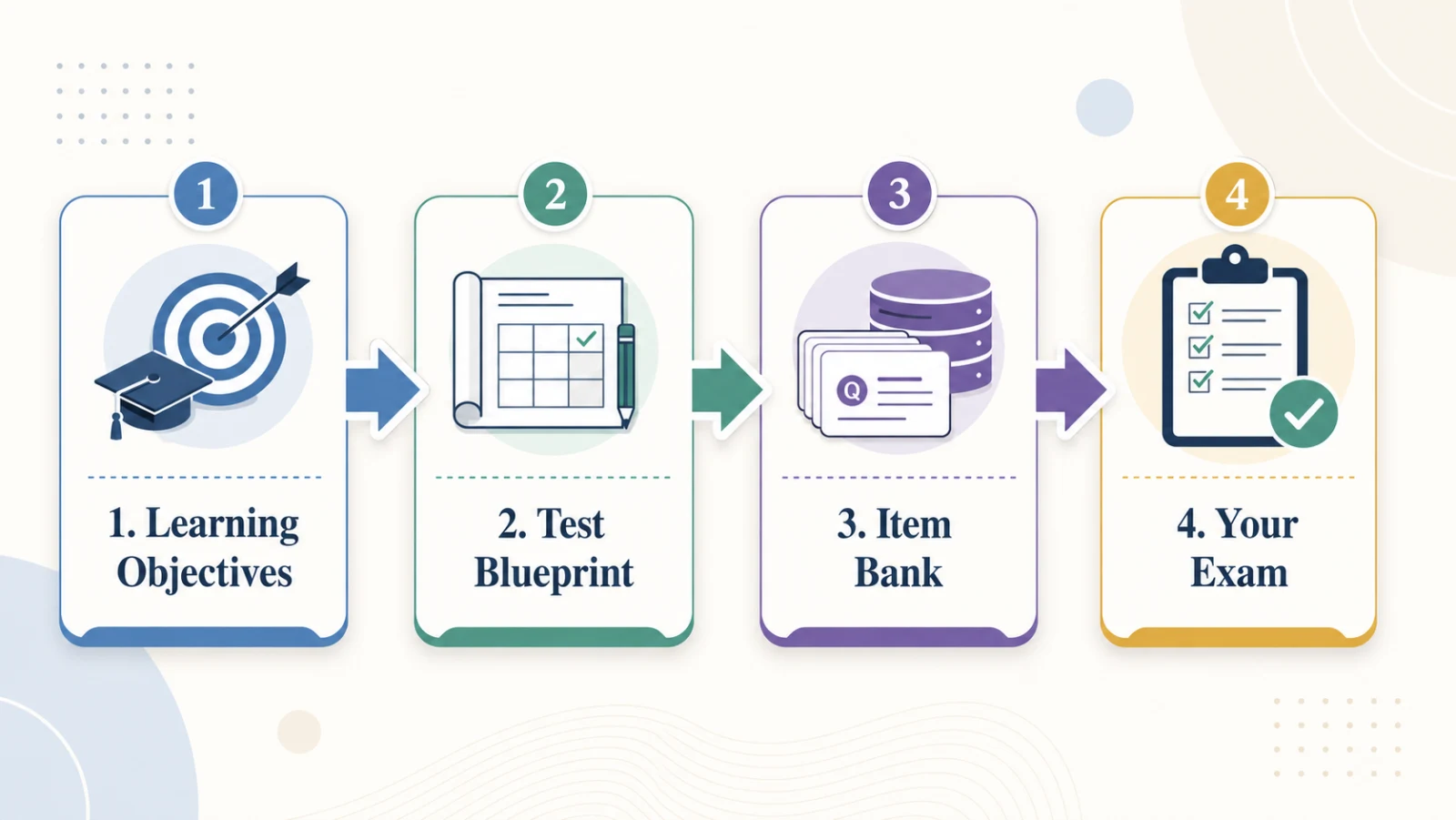
This is how exam questions are written. By the time students take the test, many of its most important features like coverage, weighting, and difficulty have already been decided.
Understanding how exams are setup changes how you should study. Students need to know that an exam is not simply a collection of facts from the textbook or lecture slides. It is supposed to measure whether you can meet the requirements and goals described in the course objectives.
What a test blueprint looks like
A blueprint is usually a planning grid. Topics are listed down one side, while cognitive levels are listed across the top. This format is standard enough that universities publish their own blueprint guides for faculty.
Here is a real test blueprint for 2019 fall class second exam Principles of Accounting II
| Exam 2 content areaTopic | RecallRec | UnderstandingUnd | ApplicationApp | AnalysisAna | Total itemsItems | Exam weightWeight |
|---|---|---|---|---|---|---|
| Plant assets, depreciation, and disposals | 2 | 3 | 5 | 2 | 12 | 30% |
| Current liabilities and payroll accounting | 2 | 2 | 4 | 1 | 9 | 22.5% |
| Long-term liabilities and bonds payable | 2 | 3 | 5 | 2 | 12 | 30% |
| Shareholders’ equity and dividends | 2 | 2 | 2 | 1 | 7 | 17.5% |
| Total | 8 | 10 | 16 | 6 | 40 | 100% |
Each number represents a deliberate choice. Plant assets, depreciation, and disposals, for example, will not be assessed mainly through definitions; most of its questions will require students to apply and tackle problem-solving questions.
The blueprint also reveals if there is imbalance before the exam is given. Without a blueprint, professors can unintentionally overuse material that was taught recently, topics that are easy to turn into multiple choice questions, or chapters that happen to have many available test bank items.
How weighting is decided
Topic weighting should be based on educational importance rather than textbook length alone. Professors may consider how much class time a topic received, how central it is to the course overall, how many objectives depend on it, and whether it is essential in understanding later material.
A short but foundational topic may therefore receive more questions than a longer but less important chapter. Likewise, material that appeared repeatedly in lectures, assignments, and discussions is more likely to get higher weight.
Professors must also decide how much of the exam will test basic knowledge and how much will require deeper thinking. Recall questions ask students to identify or recognize information, while application and analysis questions ask them to use that information in more practical ways.
This is the reason why a student may leave an exam saying, “I knew the material, but the questions were harder than the notes.” The student may have remembered the information very well, but the blueprint required a level of thinking that memorization alone did not develop.
The blueprint mistake I made
Early in my teaching at the University of Jordan, I gave a Principles of Accounting II exam during the spring semester that turned out to be much harder than I had intended. On paper, the blueprint looked balanced: long-lived assets, current liabilities, bonds payable, and shareholders’ equity were all represented.
The problem was the required level of thinking. Students were not simply identifying a depreciation method or recalling how a bond discount appears on the financial statements; they were solving multi step problems involving partial-year depreciation, asset disposals, bond amortization, carrying values, and several accounts at once.
After the exam, the scores were dramatically lower than I expected. The class average was just 13 out of 30, confirming that the exam was much harder than I had intended.
As I reviewed the questions one by one, I realized that there was no single item or topic the class had not covered.
The difficulty was built into the whole exam. I had asked students to interpret unfamiliar information, choose the correct accounting treatment, perform calculations, and identify the financial-statement effect again and again, with almost no straightforward questions in between.
That experience changed how I build blueprints. On the next exam, I kept challenging items on bonds, asset disposals, and equity transactions, but I balanced them with questions on classification, standard journal entries, terminology, and familiar calculations. In other words, I used questions that can be answered by the average student.
I was not trying to make the exam easier but fairer to ensure that the difficulty came from the accounting objectives themselves, not from making nearly every question a multi-step test of analysis.
Your syllabus might reveal part of the blueprint
Students almost never receive the completed test blueprint, but they are often given part of it in the syllabus. Specifically look for sections titled Learning Objectives, Course Outcomes, or What You Should Be Able to Do.
Most students do not read these sections carefully. They just focus on the required textbook and grading sections. That is one of the most useful opportunities they miss.
The verbs in an objective often reveal the likely cognitive level of future questions. Verbs like “Define” and “identify” suggest recall and memory skills, while “explain” and “summarize” suggest direct understanding. “Apply,” “compare,” “differentiate,” and “evaluate” indicate that memorizing definitions will not be enough.
Turn each objective into a study task. When an objective says compare, practice explaining similarities and differences; when it says “apply,” practice using the idea in a new example or scenario.
The learning objectives on your syllabus are encrypted disclosure of the exam blueprint. Reading them is not a trick. It is one of the clearest ways to understand what the course is actually asking you to learn.
CHAPTER 02Why Some Questions Feel Impossible
Students often mistakenly assume that a hard test question must be testing difficult material. Sometimes that is true, but very often the real cause of difficulty comes from what the question asks you to do with the material rather than the material itself.
The same fact can be tested at several levels. Suppose you have learned that depreciation allocates the cost of a long-lived asset over its useful life.
A straightforward question would ask you to identify the correct definition of depreciation. You either remember it or you do not.
A slightly harder question might ask you to explain why depreciation is recorded in the first place. Now you must understand the purpose of the concept, not simply recognize the wording from your notes.
An application question might give you the cost, useful life, residual value, and purchase date of an asset and ask you to compute depreciation expense. The underlying concept has not changed, but you must decide which information matters and use it correctly.
An analysis question might describe an asset sale and ask you to determine the effect on depreciation, accumulated depreciation, cash, and the gain or loss. Again, the content is the same; the work required by the question is different.
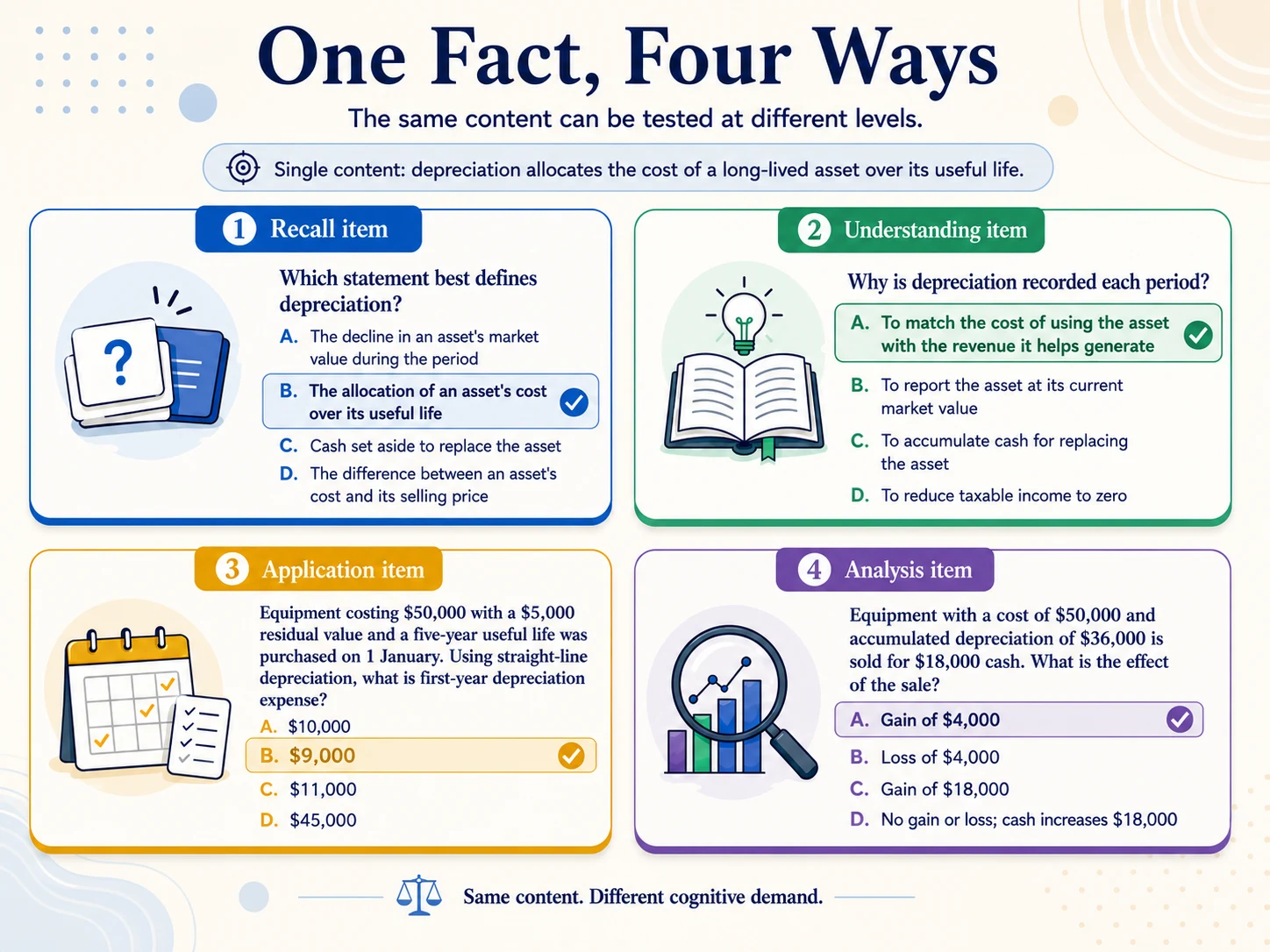
That is the central point: the topic tells you what you need to know, but the verb tells you how deeply you need to know it. Words such as identify, explain, calculate, compare, analyze, and evaluate are not interchangeable, and they are written for a purpose.
This is why two questions about the same topic can feel completely different. One asks you to retrieve information that you memorize, while the other asks you to connect several ideas together, ignore irrelevant details, choose a method, and defend a conclusion.
The difficulty may also come from the number of decisions hidden inside the question. A student solving a bond problem, for example, may need to identify whether the bond was issued at a premium or discount, calculate interest expense, update the carrying value, and select the correct journal entry.
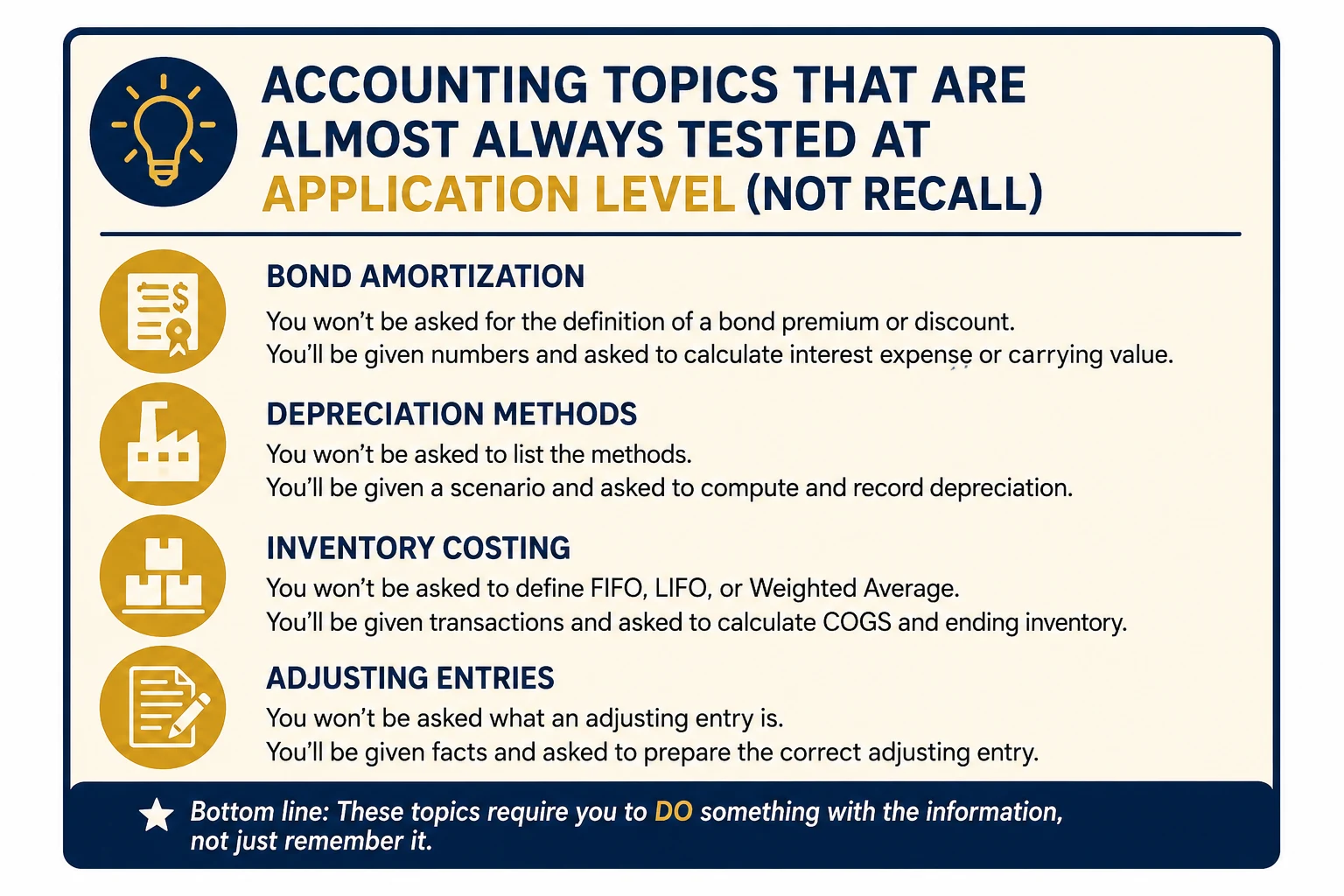
None of those steps may be unfamiliar on its own. What makes the item hard is the order they must be completed at, without being told which rule to use at each step.
This helps explain a common pattern in college courses around the world. Students simply study by reading notes, memorizing definitions, and reviewing solved examples and exercises until everything looks familiar. They think they are now ready for the exam.
That approach can work on quizzes because those assessments may focus on basic terms, short calculations, and one concept at a time. Quizzes test your very basic skills in understanding the material. Students receive good scores and assume that their study method is working.
Then they reach a midterm or final exam that combines chapters and asks them to integrate and apply ideas in a way that is different from what they used to. Suddenly, the same students feel that they have forgotten everything.
They try to adjust by studying longer. But the real problem is not the amount of effort and how long they spent studying; it is the level at which the effort is applied.
You cannot prepare for an “analyze” question by practicing only “identify” questions. You cannot prepare for an integrated problem by repeatedly working out a completed solution and thinking, “Yes, that makes sense.”
A better approach is to change the action you perform when you are studying. After learning a concept, explain it without looking at your notes, use it in a new example, compare it with a similar concept, and practice deciding which method or equation to use before beginning the calculation. Research on study techniques points the same way: practice testing outperforms rereading.
When a question feels impossible to answer, it does not always mean you never learned the material or read the chapter. It may indicate you learned it at one level and were tested at another.
CHAPTER 03Anatomy of a Question — and How I Write the Wrong Answers
When I write an item, I start with the objective, then the correct answer, then I brainstorm what a student who understands the topic at a basic level would say. That order matters because a good multiple-choice question is not a correct answer surrounded by nonsense and irrelevant mistakes.
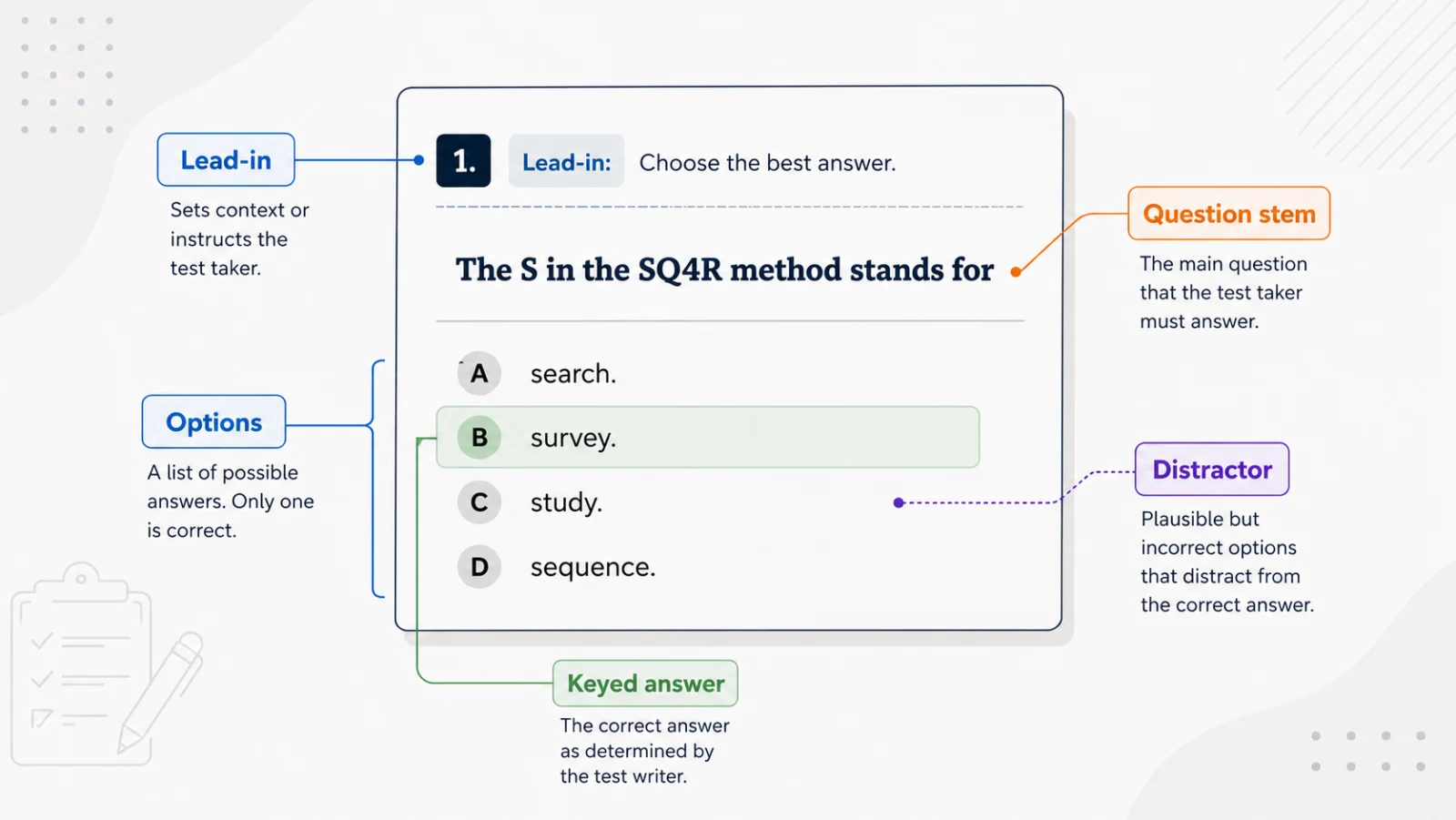
I view every item as three parts: the stem, the key, and the distractors. The stem is the question or problem, the key is the correct answer, and the distractors are the plausible wrong answers. Some items also have a lead-in, which is a short instruction that sits above the question itself.
The stem does most of the work. It tells the student what situation to consider, what information matters, and what decision must be made. It tells students what they should be looking for.
Many errors start in the stem before a student reads a single option. A student may overlook the word “omitted,” confuse “net income” with “cash,” or answer the question they expected instead of the one actually asked.
That is why I try to make the stem complete enough that a prepared student begin to answer before seeing the choices. I do not want the options to repair an unclear question.
Consider this item:
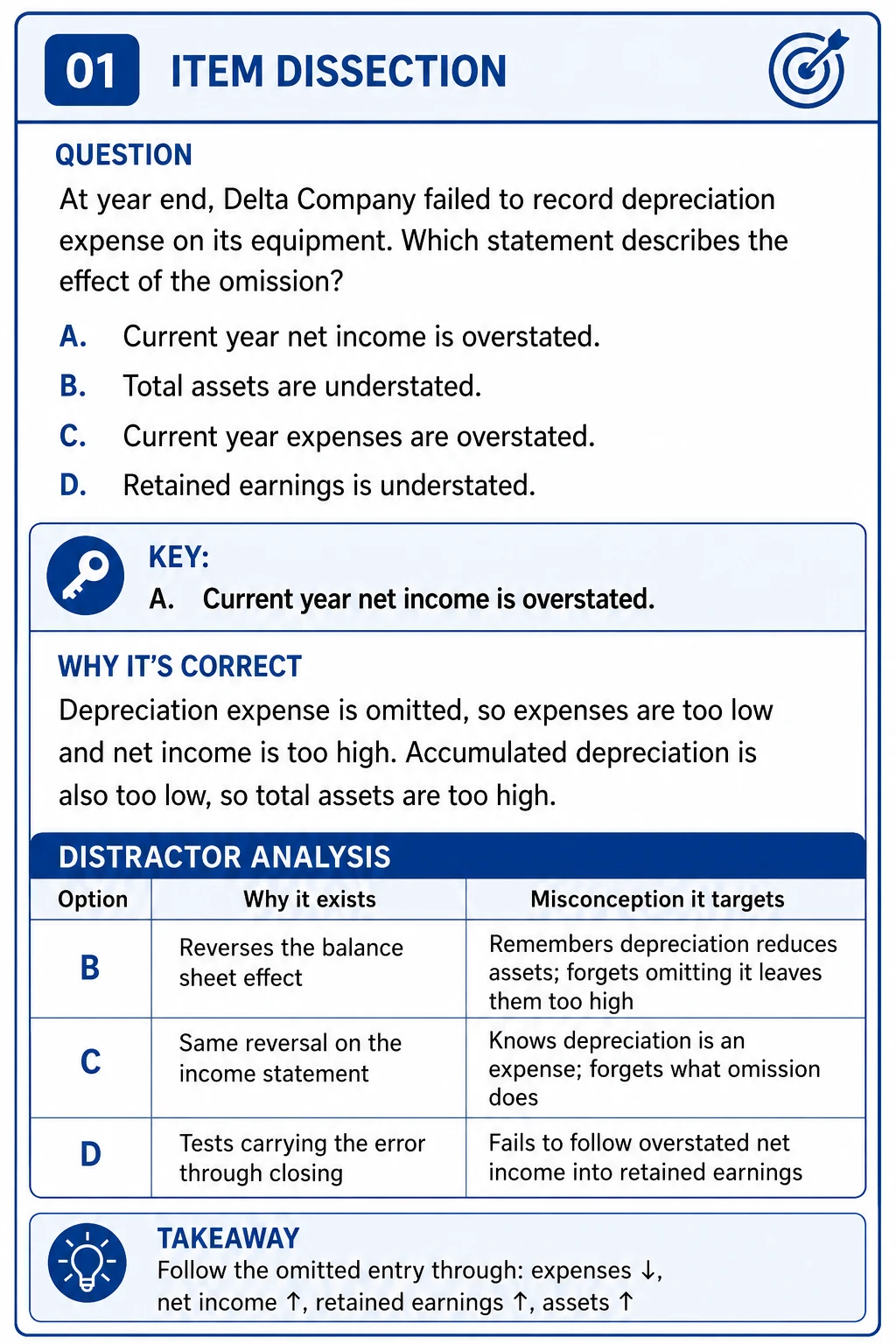
At year end, Delta Company failed to record depreciation expense on its equipment. Which statement describes the effect of the omission?
- Current year net income is overstated.
- Total assets are understated.
- Current year expenses are overstated.
- Retained earnings is understated.
The key is A. If depreciation expense is omitted, expenses are too low, so net income is too high; accumulated depreciation is also too low, so total assets are too high.
When I write this item, I decide on that reasoning first. I only write the 3 other options when I am 100% sure the correct answer is right.
Students are often surprised by this order. I write each wrong answer to represent a specific misunderstanding or confusion a student might have, that is why the distractors are usually harder to write than the key.
A distractor is a diagnosis
I do not consider a distractor successful just because it is false. I want it to be false for a recognizable reason.
When a student selects one, I want the choice to reveal a reversed relationship, a confused concept, an incomplete rule, or a misapplied ideas.
In the depreciation item, option B, “Total assets are understated” captures a common reversal. The student remembers that depreciation reduces an asset’s value but may forget that omitting depreciation leaves the asset balance too high.
Option C, “Current year expenses are overstated”, uses the same reversal on the income statement. The student recognizes that depreciation is an expense but forgets what happens when it is omitted.
Option D, “Retained earnings is understated”, tests whether the student can carry the error through closing. Because net income is overstated, retained earnings will be overstated too.
Each wrong answer is should reflect feedback about student’s reasoning. It shows not only that the student missed the item, but also the underlying flaw in their reasoning.
The common misconception
The most powerful distractor is the misconception I hear repeatedly in class. If students regularly confuse market value with cost allocation, I build that confusion into an option. This is standard practice in item writing: strong distractors are built from documented student misconceptions.
For example, I might write:
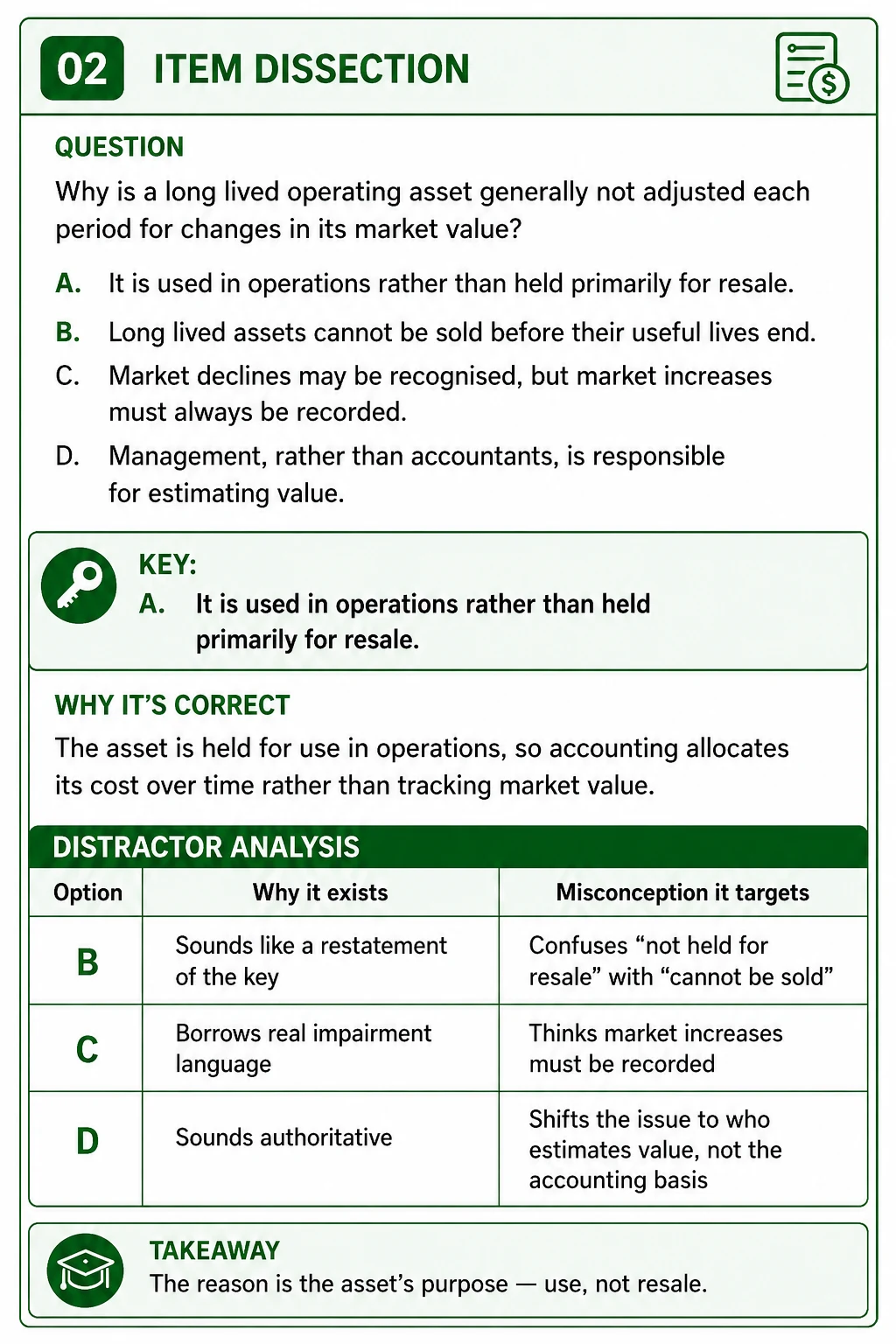
Why is a long lived operating asset generally not adjusted each period for changes in its market value?
- It is used in operations rather than held primarily for resale.
- Long lived assets can not be sold before their useful lives end.
- Market declines may be recognized, but market increases must always be recorded.
- Management, rather than accountants, is responsible for estimating value.
The key is A. Option B reflects the mistaken belief that “not held for resale” means “cannot be sold,” while option D sounds authoritative but shifts the issue away from the accounting basis being tested.
The right answer to a different question
I also use statements that are true but answer something else. This catches students who recognize familiar wording structure and stop reading carefully.
Suppose I ask what appears in the heading of a statement of cash flows. The correct answer is the company name, the statement title, and the period covered.
A distractor might list the company name, the statement title, and the date the statement was prepared. Those details sound professional, but a preparation date is not the reporting period.
This distractor catches students who remember what a financial statement looks like but have not separated the purpose of each element.
The partially true answer
I sometimes write an answer containing both correct and incorrect information. This tests whether the student understands the whole picture rather than recognizing one familiar phrase.
In the depreciation example, I could write: “Net income is overstated and total assets are understated.” The first half is correct. The second half is not.
A student who reasons correctly through the income statement but loses track of the balance sheet will select it. A student who follows the omitted entry all the way through will reject it.
The right idea at the wrong scope
Another pattern I use is the correct principle applied too broadly or too narrowly. The answer may be reasonable somewhere else, but not in the scenario described.
For example, saying that accountants never consider changes in the value of long lived assets is too broad. Impairment and other measurement requirements may matter, even though ordinary depreciation does not attempt to track market value.
The word “never” makes the claim inaccurate. I use this pattern carefully because I want to test accounting scope, not reward students for hunting absolute words.
If a distractor is silly, unrelated, or impossible to defend, I remove it.
A good item gives a well prepared student one single clear answer and gives a partially prepared student several tempting options. The wrong answers are not just fluff; They distinguish students who deeply know the topic from those who just memorize wording.
When I review an item, I ask three questions: Is the task clear in the stem? Is the key correct without qualification? Does each distractor represent a mistake a real student might make?
If the answer to any of those is no, I revise the item. The quality of a multiple choice question depends on both right answer and wrong options.
| Type | What it tests | What choosing it reveals about you |
|---|---|---|
| The common misconception | Being able to distinguish between the correct answer and an error students frequently make. | You remember the topic, but your reasoning may contain a specific misunderstanding. |
| The right answer to a different question | How well you read the question’s stem rather than choosing a familiar statement. | You answer the question you expected to see rather than the one that was actually asked. |
| The partially true answer | Whether you understand the complete rule rather than spotting one accurate phrase within an answer option. | Part of your knowledge is correct, but instead of checking the complete answer you may stop once you spot partially correct statement. |
| The right idea at the wrong scope | Whether you understand when a rule applies. | You know the general principle, but you may be applying it too broadly or too narrowly. |
CHAPTER 04What Your Professor Sees After the Exam
When students submit an exam, all they see is a score and perhaps a list of missed questions. I check another layer: a statistical report showing how every item performed across the entire class.
The first number is item difficulty, which indicates the percentage of students who answered the question correctly. A difficulty value of 70% means that 70% answered correctly, so the item was relatively accessible.
I also look at discrimination: It measures the difference between a student who studied hard and a student who didn’t. If a question can be answered by prepared student and unprepared student, that question has zero discrimination. The question becomes bad if a student who didn’t open the textbook could still get a good grade. That is why this kind of questions should be limited.
Then I examine the distribution of the responses. This shows how many students selected the key and how many selected each distractor.
Consider the depreciation question from the previous chapter. In a class of 84 students, the responses distribution was:
| Option | Response | Students selecting it |
|---|---|---|
| A | Net income is overstated — key | 52 (61.9%) |
| B | Total assets are understated | 18 (21.4%) |
| C | Expenses are overstated | 10 (11.9%) |
| D | Retained earnings is understated | 4 (4.8%) |
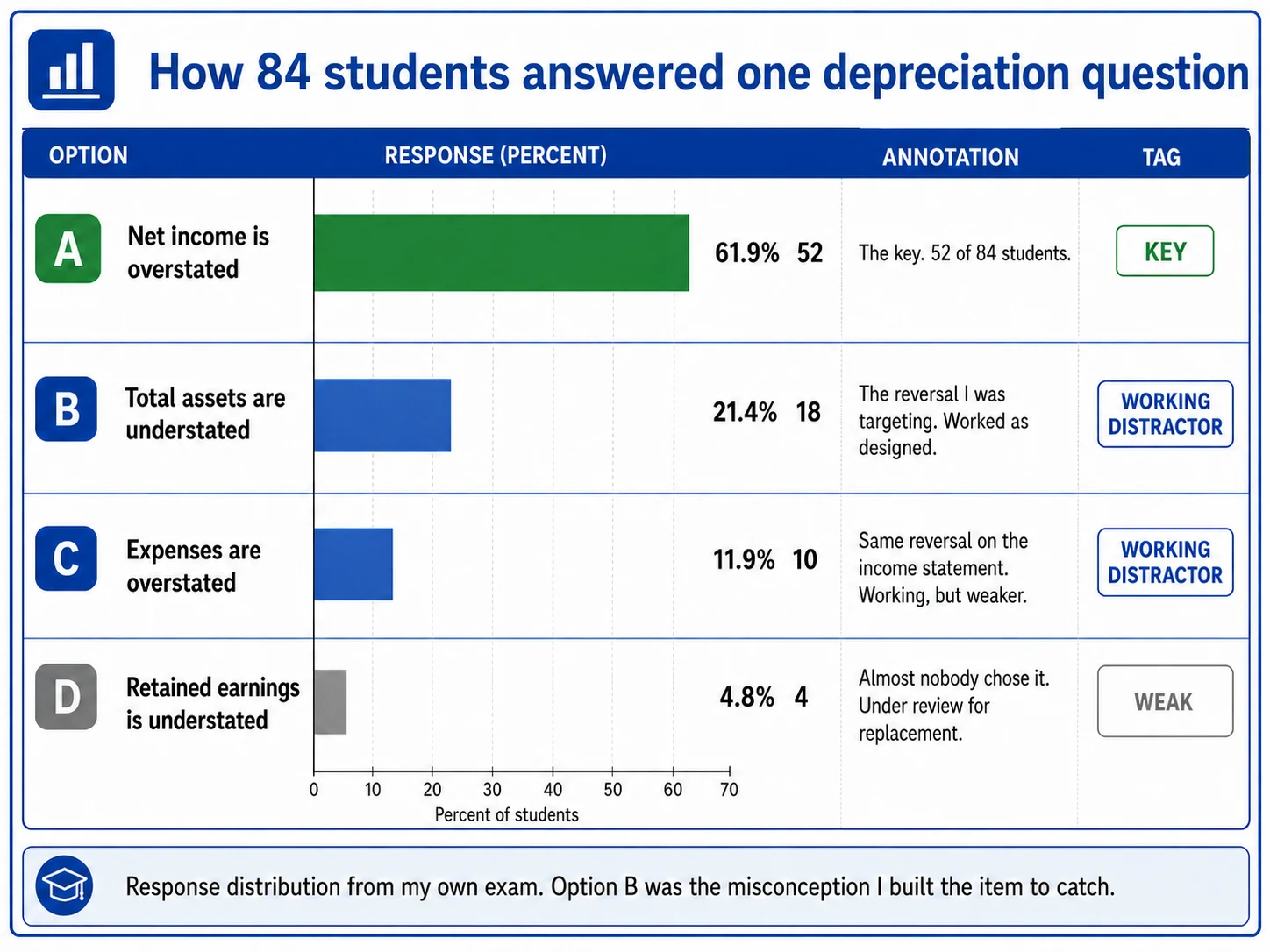
This would tell me more than “32 students were wrong.” Option B is clearly working because many students reversed the effect of omitted depreciation on assets.
Option C is also functioning, though less strongly. Option D attracted only a few students, so I would review whether it represents a meaningful misconception or is simply too easy to exclude.
A distractor that nobody selects is called a dead distractor. It contributes little because students do not seriously consider it, even when they are just guessing.
Suppose another item produced responses of 78%, 18%, 4%, and 0%. I would not discard the entire question, but I would examine the zero response option and probably replace it with an error students actually make.
Statistics can also expose a weak key or an unclear stem. If all the best students in the class got a question wrong, and they all picked the exact same wrong answer, this represents a big red flag. I check whether that option could be defended, whether the wording is ambiguous, or whether the item requires knowledge that was not taught clearly.
Weak items are revised, removed from scoring when necessary, or retired from future exams. Strong items may remain in the pool, often with small wording changes.
This is how exams evolve from one class to another. The questions that survive are usually not the trickiest ones; they are the ones that consistently separate deep understanding from familiarity, guessing, or partial recognition.
CHAPTER 05Inside a Textbook Test Bank
Not all questions in a test bank are excellent. Some are too easy, some depend too heavily on textbook wording, and some contain distractors that can be removed quickly.
That limitation is worth stating first because a test bank is not a finished exam. It is a collection of possible items that an instructor is expected to review, select, and most importantly revise before use.
When I accept a test bank commission, I do not simply receive a chapter and an instruction to write x number of questions. The publisher normally provides an item quota for each chapter, divided by question type, learning objective, and level of difficulty.
A chapter may need a set number of multiple choice, true/false, short answer, or problem solving questions. The goal is to create enough coverage that instructors can create multiple versions of quizzes, midterms, and final exams without running out of questions.
The publisher often provides a clear style guide. It specifies how stems should be written, how long the options can be, whether negative wording is allowed, how calculations should be rounded, and how close wording must match the textbook.
Consistency matters because a test bank may contain thousands of items written by several authors. Without standardized guidelines, the wording, difficulty, and formatting would dramatically change from one chapter to another.
Every item must also be tagged. At a minimum, I usually identify the chapter objective being tested and the level of thinking required to answer the question, such as remembering, understanding, applying, or analyzing.
Those tags are not included simply for decoration and record keeping purposes. They give the instructor the same insights used in an exam blueprint.
Suppose a professor needs three application questions on bond accounting and one basic understanding question on shareholders’ equity. The tags allow the professor to quickly locate eligible questions without reading every question in the chapter.
After I submit a group of items, they go through editorial review. An editor checks the wording, the answer key, the relevancy to the textbook, and whether the assigned objective and cognitive level are accurate.
Items may be returned with requested changes. A calculation may need clearer assumptions, a distractor may be too obviously wrong, or an item tagged as analysis may turn out to require only recall.
Even after that process, quality still varies. Some questions work well immediately, while others reveal weaknesses when an instructor uses them with real exam results.
Numbers make this concrete. On one edition revision I worked on, the publisher’s tracker covered twelve chapters and logged what happened to every question.
| What happened to the question | Items | Share |
|---|---|---|
| Written from scratch for the new edition | 136 | 59% |
| Deleted from the previous edition | 68 | 30% |
| Kept, but revised | 25 | 11% |
| Total tracked | 229 | 100% |
Of the previous edition’s questions that were touched at all, roughly three in four were cut rather than repaired.
That is why instructors are generally advised to treat test bank items as raw material rather than using them word for word. I may shorten a stem, update a scenario, replace a weak distractor, or adjust the numbers so the item matches what my class has really practiced. Customizing items is really essential.
This matters for you as a student too. Because test bank items are tagged by objective and by level of thinking, so you can practice applying a concept rather than only recalling it.
A good test bank saves time and provides organized coverage. But it never replaces the professor’s judgment, the course blueprint, or the responsibility to make sure every question fits the class.
CHAPTER 06How to Study Once You Know This
Once you understand how exam questions are structured, studying for exams becomes more about targeting what the course really expects you to understand rather than just trying to cover the material.
Start with the objectives
Begin with the learning objectives in your syllabus, chapter guide, and lecture notes. Treat them as your secret blueprint.
Do not focus only on the topic. Focus on the verb.
An objective that says identify calls for a different kind of preparation from one that says compare, calculate, apply, or evaluate. The verbs tell you exactly the level at which you will be tested.
Suppose the objective says, “Explain the effect of an omitted adjusting entry on the financial statements.” Memorizing the definition of an adjusting entry will never be enough in this case.
You should be able to understand the omission, trace its effects through the accounts, and explain which amounts will be increased or decreased. That is a realistic simulation to what the exam question will require.
Practice at the right level
Students often study one level below the exam. They practice a solved problem over and over, recognize each step, but fail to recognize to be able to solve it on their own.
Recognition and production are different skills. A completed solution can feel obvious because every decision has already been made for you.
Close the book and try a new problem from the beginning. Before calculating anything, state which section applies, which accounts are affected, and what result you expect.
You can also raise the level of familiar questions. After calculating depreciation expense, ask what happens if the purchase date changes, the residual value is revised, or the asset is sold before the end of its useful life. Always test new variables within the same problem.
For a bond question, do not stop after finding interest expense. Explain why the carrying value increased or decreased and how the transaction affects the financial statements.
This does not mean you will always be tackling the hardest possible problems. You still need to work on memory and basic understanding, but those should be the foundation for application not your final goal.
Use wrong answers as feedback
When you answer a multiple choice question wrongly, do not look only at the correct answer. You need to understand why the distractor you selected seemed convincing.
Did you reverse the direction of an effect? Did you apply the right rule to the wrong situation? Did you recognize one true phrase and stop checking the rest of the option?
That mistake is the diagnosis. It tells you what you need to work on more clearly than the score does.
Keep a short error log while studying. Write down the question type, the answer you chose, why it seemed right, and what could have been done to prevent the mistake.
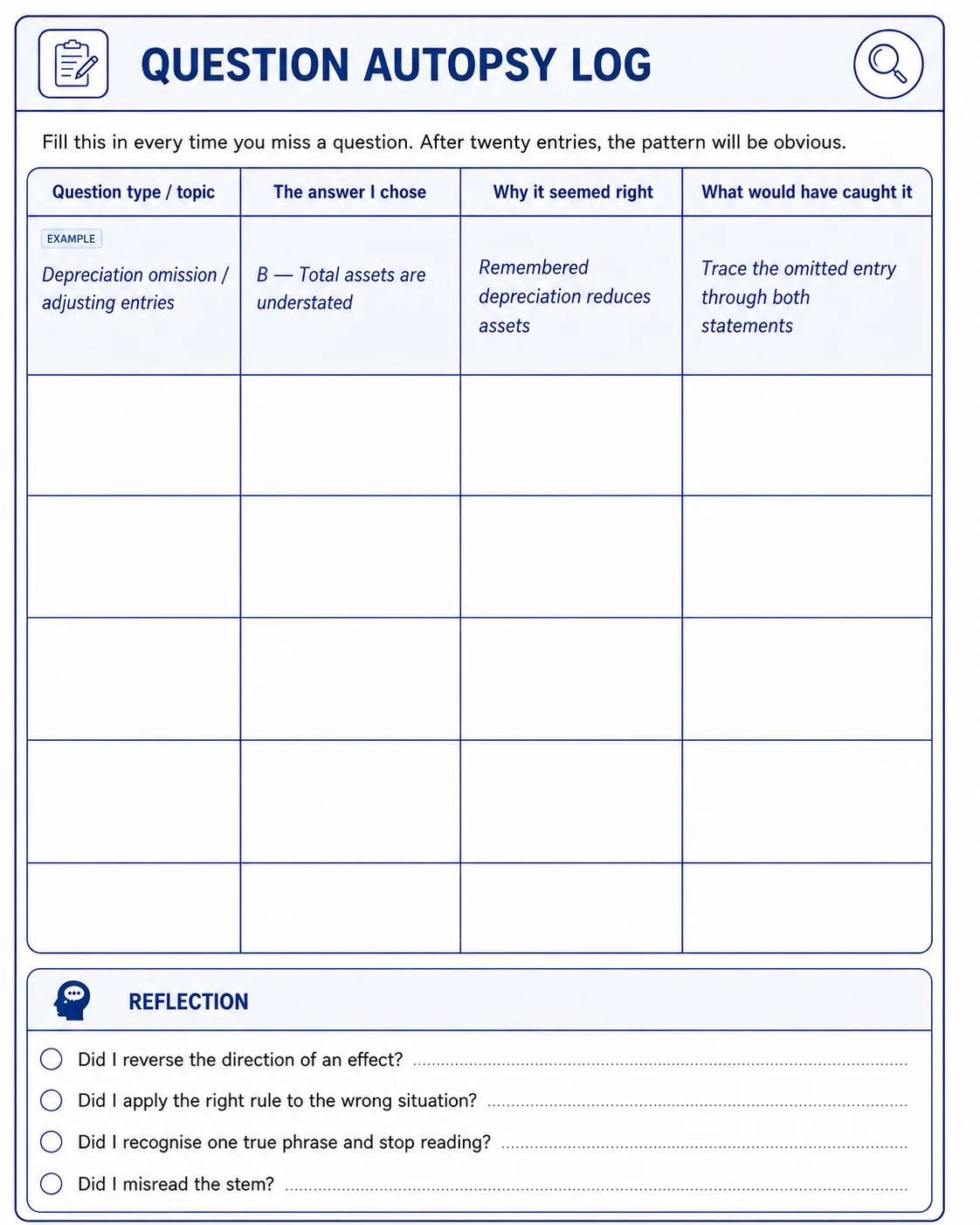
Over time, a specific pattern usually appear. You may discover that your main problem is not calculation but classification, or that you understand individual chapters but struggle when several chapters are integrated.
For a classroom-support assessment example, review the ParaPathways sample questions and explanations, then explain why each rejected option is incorrect.
Spread the practice out
It is more tempting to study one chapter for several hours until every question feels easy. The problem is that immediate repetition makes you falsely feel that your preparation is strong.
For example, If you are studying a chapter about the income statement, you will be working and focusing on revenue, expenses, and profits until you are just looking for the numbers to plug into equations you have memorized.
This makes you feel incredibly smart because you already know the pattern and already know which principles you will be using. However, if you come across a problem that integrates income statement principles with the balance sheet, you freeze.
So you need always to mix current topics with earlier ones and practice deciding which principles apply before you begin.
That deliberate delay makes practice feel harder, but it produces a more useful kind of learning. Because after all, on an exam, nobody tells you which chapter a question belongs to or which equation to use.
A word about test wiseness
Question writing flaws do exist. I have written flawed questions myself, and careful review has revealed some problems that seemed harmless when I first drafted them.
Sometimes the correct option is noticeably longer because the writer added qualifications to make it convincing. Sometimes one choice fits the grammar of the stem while the others do not.
Words such as always, never, and only can also make distractors easier to exclude. A rule with no exceptions is often harder to defend than one written more carefully.
| The tell | Why it happens | How much to trust it |
|---|---|---|
| The correct option is noticeably longer | The writer added qualifications to make the key defensible | Low — a long answer is often just a careful one |
| One option fits the grammar of the stem, the others don’t | Options were drafted separately and never reread against the stem | Low to moderate — common on rushed items, gone after review |
| Absolutes: always, never, only | Absolute claims are the easiest false statements to write | Low — some absolute statements are genuinely correct |
These patterns are real, but they are unreliable. A long answer can be wrong, an absolute statement can be correct, and an experienced question writer can make every option grammatically and visually consistent.
Review is meant to deal with this issue. I compare option lengths, read each choice directly after the stem, check for unintended hints, and ask whether a student could reach the key without knowing the course material.
Editors and other instructors often do the same. Strong test banks also use guidelines designed to prevent the most common flaws.
Test wiseness means using clever test taking tricks instead of actual knowledge. There is one situation where it is defensible: when you really do not know the answer and would otherwise guess blindly. Eliminating an option with a grammatical mismatch or an unreasonable absolute is better than a random guess.
Of course, it should never become your test-taking strategy. These clues easily disappear on well written questions, and they cannot help when every option is plausible.
Your biggest advantage is knowing how questions are designed. Read the objective, notice the verb, practice at that level, and study your mistakes the same way you do for the correct answers.
Once you do that, exam questions stop looking like surprises. They become recognizable tasks created from objectives you have already seen and ways of thinking you can practice before exam day.
CONCLUSIONThe Question Behind Every Question
Students face exams at the end of the process. The professor starts at the other end. With the learning objectives, the blueprint, the correct answers, the distractors, and the evidence collected after students respond.
When you understand that process, exam questions become less mysterious. You can start studying from the objectives, pay attention to the verbs, practice at the level the course requires, and use every wrong answer to identify the exact flaw in your reasoning.
That does not automatically make a demanding exam easy. It makes your exam preparation match what the exam was designed to measure.
The question behind every question is not simply, “Do you remember this?” It is, “What can you do with what you learned?”
FAQFrequently Asked Questions
How are exam questions written?
Professors usually begin with the course learning objectives, then they decide the weight for each topic, in addition to what level of thinking students should demonstrate. Those elements then can be grouped in the test blueprint.
What is a test blueprint?
A test blueprint is a planning grid that coordinates course objectives/topics with cognitive levels such as recall, understanding, application, and analysis. It also assigns a number of questions to each topic.
Are wrong answers on a multiple choice test random?
Good distractors are not random. They are usually based on common misconceptions, reversed relationships, incomplete rules, or correct ideas applied to the wrong situation.
Why are accounting exam questions so hard?
Accounting questions often require several decisions in sequence. A student will have to identify the logic behind the question, select the correct equation, complete a calculation, and determine the financial statement effect. Integrating multiple accounting principles on one question makes the question even harder.
Do professors reuse test bank questions?
Some professors use test bank questions, but they are expected to review them before using them on an exam. An instructor may revise the wording, replace weak distractors, change figures, or adapt the question so it matches the course objectives and classroom practice.