
How to Answer Multiple-Choice Questions: A Step-by-Step Guide
To solve multiple-choice questions, you must identify what you need to find, exclude incorrect options, then choose the answer that fits the question. Before you choose an answer, identify a fact, calculation, or subject rule that supports your answer.
This introductory guide is for students learning how to approach multiple-choice exams. You will practice interpreting instructions, comparing similar options, checking calculations, and selecting more than one answer. Each worked example explains why the correct answer fits and why the alternatives do not. The questions use everyday situations to make the method easy to follow. Apply these steps alongside studying the subject content.
In my work as a teaching assistant for psychology classes, I have noticed students choosing an answer before reading the entire answer option because it seemed correct based on the opening words alone. I now ask students to read every answer option fully before choosing an answer.
Chapter 1
A Simple Method for Solving Multiple-Choice Questions
To tackle multiple-choice questions, use four steps: identify the task, work out the answer, compare the options, and check your choice. These steps help you organize what you know and check for details you may have missed.
Identify the task
Understand what the question really asks you to find.
Work it out
Use the given facts and your subject knowledge to solve the question before looking at the answer options, where possible.
Compare the options
Next, check each choice against your analysis and reasoning.
Check your choice
Make sure your answer really matches what the question is asking.
Try the four steps on the next question and choose your answer before reading the solution.
Worked exampleFollow the Four Steps
A study session starts at 14:20 and lasts 45 minutes. What time does it finish?
- A14:55
- B15:05
- C15:15
- D15:20
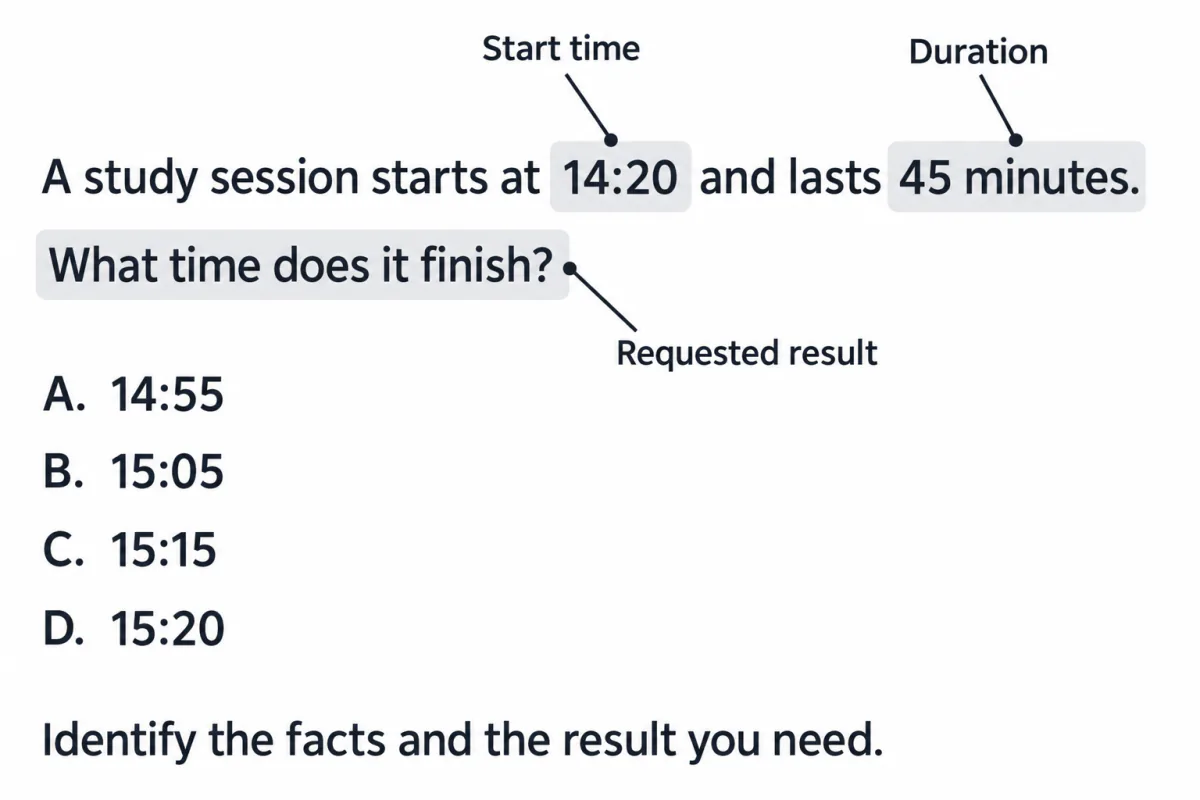
You need to find the study session’s finishing time. Add 40 minutes to 14:20 to reach 15:00. Add the remaining five minutes to reach 15:05, which matches option B.
| Option | Check |
|---|---|
| A. 14:55 | Only 35 minutes have passed. |
| B. 15:05 | Exactly 45 minutes have passed. |
| C. 15:15 | 55 minutes have passed. |
| D. 15:20 | 60 minutes have passed. |
Chapter 2
What Is the Question Actually Asking?
For multiple-choice questions, pay special attention to words such as NOT, EXCEPT, MOST, LEAST, and BEST before you choose an answer. If the question asks for the least time, tell yourself: “I need the shortest duration.”
Worked exampleChange One Word
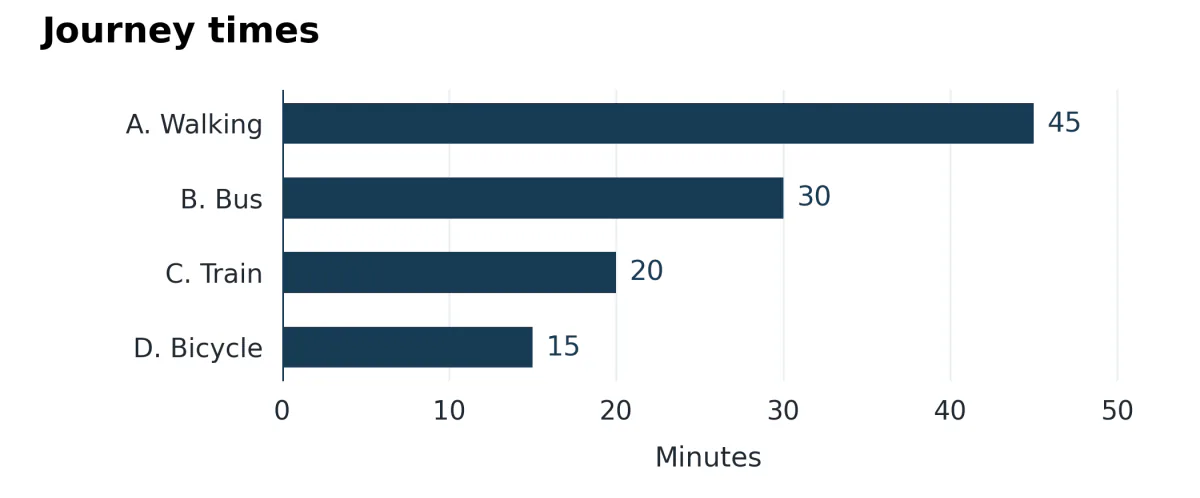
Question A: Which journey takes the MOST time?
Question B: Which journey takes the LEAST time?
Choose one answer for each question.
For MOST, choose A: walking takes 45 minutes, the longest journey time. For LEAST, choose D: the bicycle journey takes 15 minutes, the shortest time. B and C are neither the longest nor the shortest journeys, so neither answers these questions.
For NOT or EXCEPT questions, look for the option that does not meet the rule stated in the question. If you must bring a pencil and notebook but do not have to bring a calculator, the calculator is the answer to “Which item is NOT required?”
| Question word | What to do |
|---|---|
| NOT / EXCEPT | Find the option that does not fit the rule. |
| MOST / LEAST | Find the largest or smallest value, as asked. |
| BEST SUPPORTED | Choose the answer supported by the given facts. |
| FIRST / NEXT | Find the first step or the step that comes next. |
Chapter 3
How to Eliminate an Answer—and Explain Why
Exclude an option when it contradicts a fact, fails a stated condition, or breaks a relevant subject rule. An unfamiliar answer may still be correct, so eliminate it only when you can identify a fact, condition, or subject rule that it violates. Check the whole statement; the word “always” alone does not make an answer incorrect.
Worked exampleCheck Every Requirement
A library opens at 09:00 and closes at 17:00. Room bookings must last exactly 60 minutes and remain entirely within opening hours. Which booking is valid?
- A08:30–09:30
- B11:00–11:30
- C15:30–16:30
- D16:30–17:30
Your booking must last exactly 60 minutes. It must also start at or after 09:00 and finish at or before 17:00.
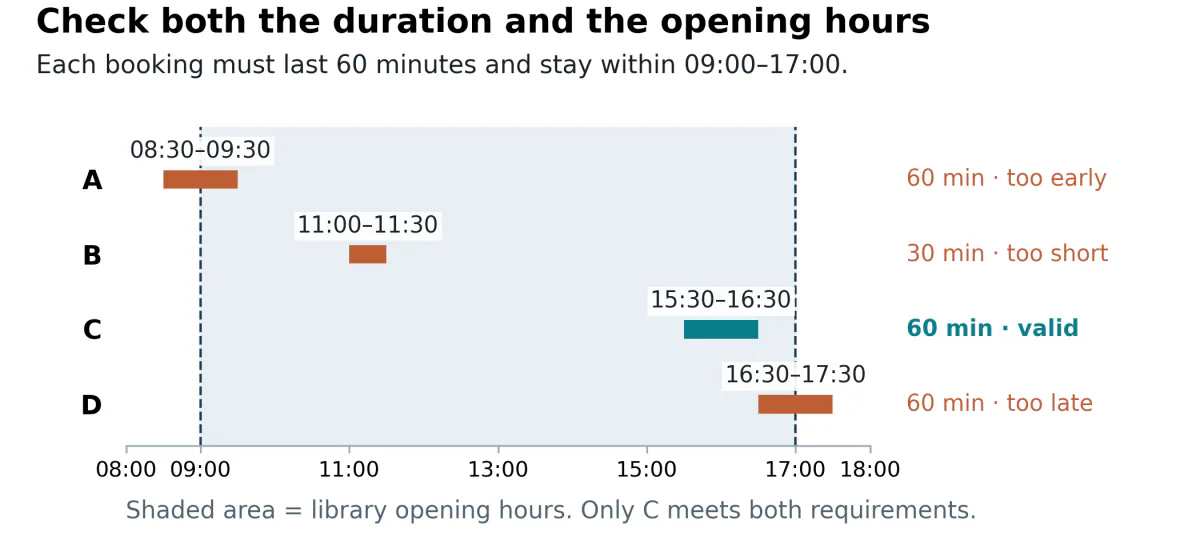
C is correct because 15:30–16:30 lasts 60 minutes and falls within opening hours. A starts before the library opens, B lasts only 30 minutes, and D ends after the library closes.
Before ruling out an answer, ask yourself: “Why is this option wrong?” If you cannot explain why an option is wrong, keep it under consideration while you compare the remaining options.
Chapter 4
Two Answers Look Correct: How Do You Choose?
When two answers seem plausible, focus on the facts in the question that support each one. If the question asks what the passage supports, use its information without adding your own assumptions.
Worked examplePlausible or Supported?
During a one-week trial, the library extended its closing time from 6 pm to 8 pm. Staff recorded 40 visits after 6 pm. They did not compare total daily visits with earlier weeks.
Which conclusion is best supported by the passage?
- ASome visitors used the additional opening hours.
- BMore people visited the library overall than in earlier weeks.
- CEvery late visitor previously visited before 6 pm.
- DThe additional opening hours improved students’ exam scores.
A is correct because the 40 visits after 6 pm show that people used the additional opening hours. To choose B, you would need a comparison of total visits with earlier weeks, which the passage does not provide.
C claims every late visitor previously came before 6 pm. The passage tells us nothing about their previous visits. D claims that the extra hours improved exam scores; however, the passage does not provide exam results.
Chapter 5
Your Calculation Matches an Option. Is It Correct?
A distractor is an incorrect answer option that can look correct. In a calculation question, a distractor may match the result you get from dividing by the wrong value.
Worked exampleFind the Correct Percentage
A price increases from $80 to $100. What is the percentage increase?
- A20%
- B25%
- C80%
- D125%
Subtract the original $80 from the new $100 to find the $20 increase. Divide the $20 increase by the original price of $80. The percentage increase is $20 ÷ $80 × 100 = 25%, so B is correct.
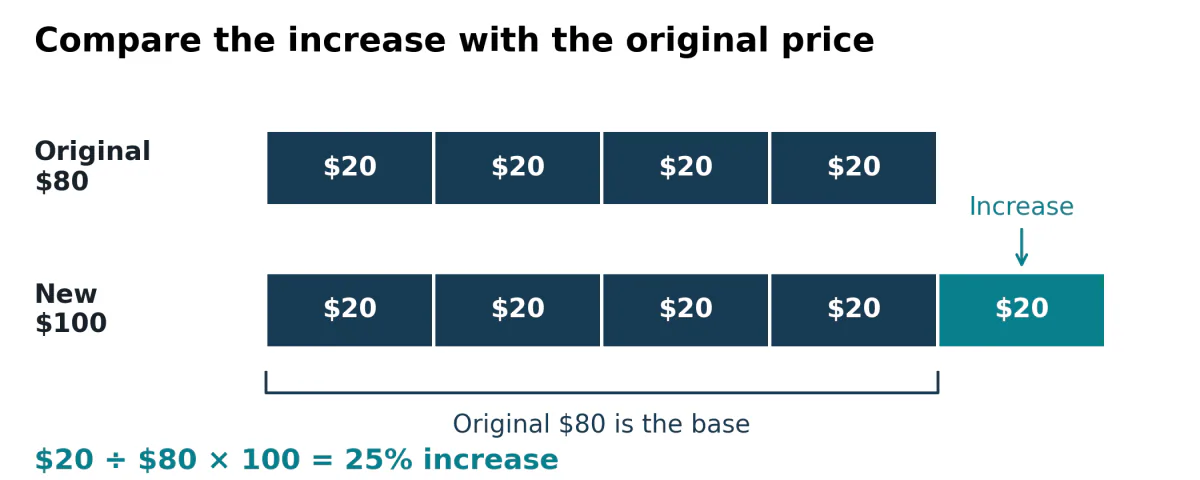
You get A’s 20% if you divide the $20 increase by the final $100 price instead of the original $80. Before dividing, ask yourself: “What was the price before it went up?”
C’s 80% comes from 80 ÷ 100 × 100: it expresses the original price as a share of the final price. D’s 125% comes from 100 ÷ 80 × 100: it expresses the final price as a share of the original price, including the starting 100%. Neither measures the percentage increase.
Chapter 6
“Select All That Apply”: Check Every Option
For “select all that apply” questions, check each statement separately against the facts you are given. Keep checking after you find one correct statement because other statements may also be correct.
Worked exampleMore Than One Correct Answer
For this example, select every correct option and no incorrect ones.
A club has 24 members. Six are absent from a meeting. Select all correct statements.
- AEighteen members are present.
- BTwenty-five percent of the members are absent.
- CSeventy-five percent of the members are absent.
- DThree-quarters of the members are present.
Subtract the six absent members from 24 to get 18 members present. The six absent members make up 6 out of 24, which is one-quarter or 25% of the club. The 18 present members make up 18 out of 24, which is three-quarters or 75% of the club.
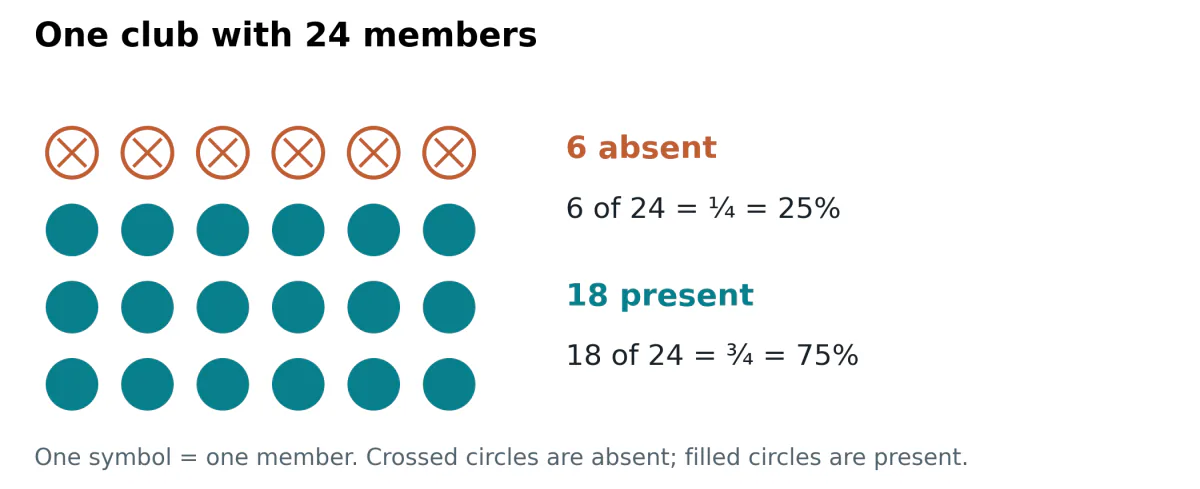
Select A, B, and D. A gives the 18 members present; B gives the 25% absent; and D gives the three-quarters present. C is incorrect because 75% are present, not absent.
Chapter 7
What Should You Do When You’re Stuck?
Before any exam, check whether you can skip questions, return to earlier questions, or leave answers blank, and whether incorrect answers lose marks. Confirm these rules with your instructor beforehand or check the exam’s current official instructions.
When to Move On
Set a rough time budget using the exam’s duration and the marks available for each question. Allow more time for questions that require more work, and reserve review time if you can return to earlier questions. If your exam allows you to return, mark a question for review when you cannot make further progress.
If your exam allows you to choose the order, answer the questions you are confident you can solve first. Avoid spending too much time on hard questions while easier ones remain unanswered. Then use the time left to return to the questions you have not solved.
If you cannot go back to a question, compare the remaining options with the given facts before choosing an answer.
When Guessing Makes Sense
Imagine a question with four options and exactly one correct answer. You have no information favoring any option, so a random guess has a one-in-four chance of being correct. Leaving the question blank earns zero marks. In the examples below, a correct answer earns one mark.
The chart compares four different penalties for wrong answers. With four options, 100 random guesses would average about 25 right and 75 wrong.
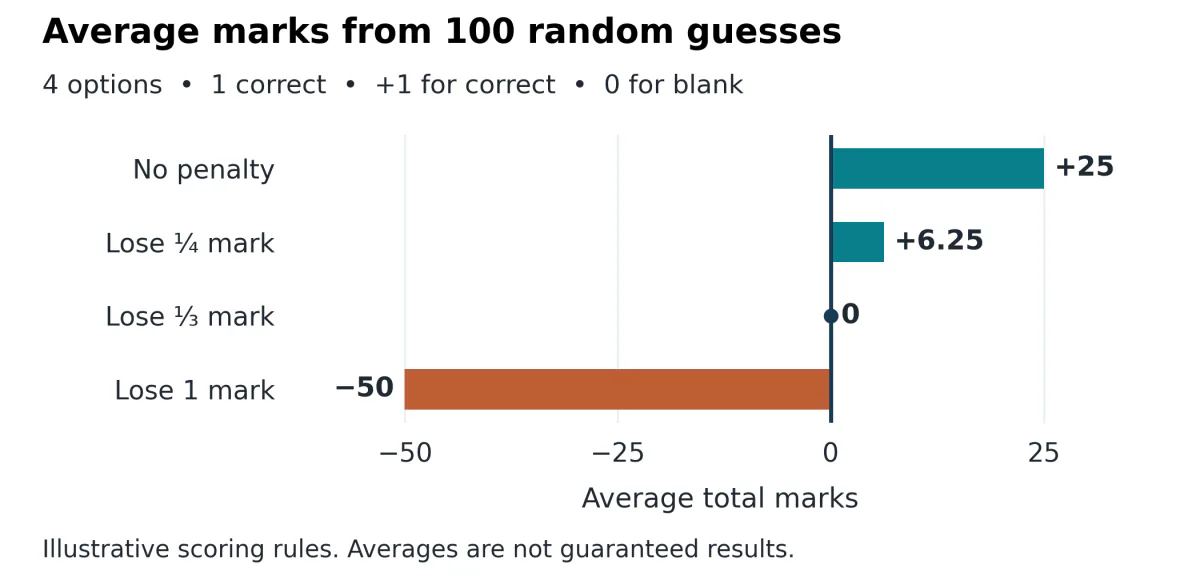
For example, with a one-mark penalty, 25 correct answers earn 25 marks, but 75 wrong answers lose 75 marks. The total is −50 marks.
Leaving all 100 blank earns 0. These are averages, not promised results.
First, eliminate only options you can show are wrong. If wrong and blank answers both earn zero, answer every single-answer question, even if you must guess. If wrong answers lose marks, guessing depends on the scoring rules and your chance of being correct. In the chart, random guessing gains marks on average with no penalty or a quarter-mark penalty, breaks even with a one-third-mark penalty, and loses marks with a one-mark penalty. Correct elimination can improve those odds.
When to Change an Answer
When reviewing an answer, choose the option best supported by the question and your subject knowledge. Change your choice if further thought reveals a stronger reason for another option, such as a missed condition or a corrected calculation. For example, if you chose the largest value but the question says LEAST, change your answer to the smallest value.
If you feel unsure, read the question again and check your reasoning. Feeling unsure does not mean another answer is right.
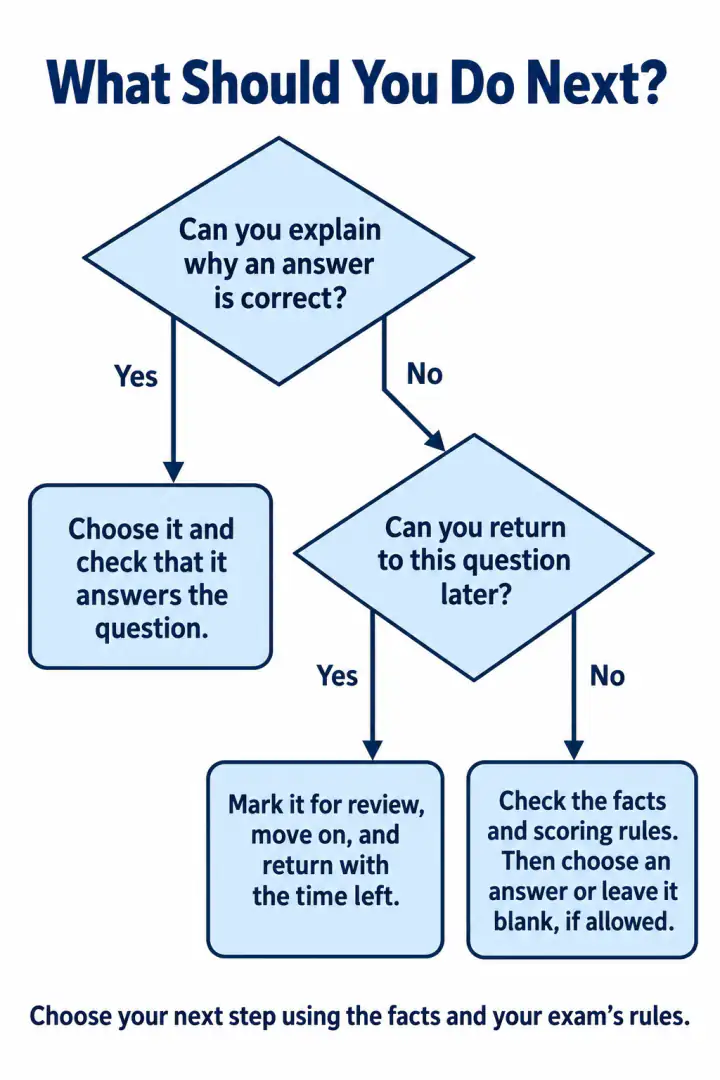
- You can explain your answerChoose it and check that it answers the question.
- You are unsure and can return laterMark the question, move on, and return with the time left.
- You are unsure and cannot returnCheck the facts and scoring rules before answering or leaving it blank, if allowed.
Chapter 8
Try It Yourself: Can You Explain Your Answer?
Try all three questions before reading the answers and explanations. For each answer, write one sentence naming the fact, instruction, or calculation that supports your choice. Use your mistakes to choose what to practice next.
After these exercises, try one passage-based question and one ‘select all that apply’ question from your course materials. For each option, give a reason to select or reject it.
Practice 1Read the Instruction
A workshop requires a pencil, ruler, and notebook. A calculator is optional. All these items are required EXCEPT:
- APencil
- BRuler
- CCalculator
- DNotebook
Practice 2Check Both Conditions
You need a notebook with at least 80 pages costing no more than $4. Which option meets both conditions?
- A60 pages for $3
- B100 pages for $5
- C80 pages for $4
- D70 pages for $4
Practice 3Check the Percentage Base
A price falls from $50 to $40. What is the percentage decrease?
- A10%
- B20%
- C25%
- D80%
Answers and Explanations
Practice 1 · Answer: C
Practice 1: C is correct because the calculator is optional. The pencil, ruler, and notebook are all required, so none is the exception. When you see EXCEPT, look for the option that does not belong to the group the question describes.
Practice 2 · Answer: C
Practice 2: C is correct because its 80 pages meet the minimum and its $4 price stays within the budget. A has 60 pages and D has 70, so both fall below the 80-page minimum. B has enough pages, but its $5 price exceeds the $4 budget.
“At least 80” includes 80, and “no more than $4” includes $4. Check every condition before deciding that an option fits.
Practice 3 · Answer: B
Practice 3: subtract $40 from $50 to find the $10 decrease. Divide $10 by the original $50 and multiply by 100: 20%, so B is correct.
| Option | Feedback |
|---|---|
| A. 10% | This confuses the $10 decrease with a 10% decrease. |
| B. 20% | This correctly compares the $10 decrease with the original $50. |
| C. 25% | This divides by the final price: 10 ÷ 40 × 100. |
| D. 80% | This measures the amount remaining: 40 ÷ 50 × 100. |
Review any question you guessed, even if you selected the correct answer. Use the table in the next section to identify any gap in your knowledge or reasoning and choose what to practice next.
Chapter 9
Turn Each Wrong Answer into a Better Next Attempt
After practice, write down the reason for each mistake. Replace “I was careless” with a specific note, such as “I missed EXCEPT and chose a required item.”
| What happened | Type of mistake | What to do next |
|---|---|---|
| I could not remember the needed concept. | Knowledge | Review the concept, then try a new question. |
| I answered MOST when the question said LEAST. | Reading | Mark the key word and say what the question asks. |
| I assumed evening visits meant more total visits. | Reasoning | Check what the facts show and what you have assumed. |
| I divided the increase by the final price. | Calculation | Label the starting value before calculating. |
| I spent too long without making progress. | Time management | Practise a time plan that follows your exam’s rules. |
If you missed EXCEPT, try a fresh question with negative wording. Restate what it asks, answer without looking at the solution, and then check whether you avoided the same mistake.
Choose a practice set for your exam that targets the skill you need to improve.
Conclusion
Identify the task, work out the answer where possible, compare every option, and check your choice. Follow your exam’s rules when managing time or guessing. After practice, explain each mistake and try a fresh question that tests the same skill. Start with one question today and make sure you can explain why your answer fits.
Further reading