
Description
FOR COLLEGE GENERAL BIOLOGY I & II
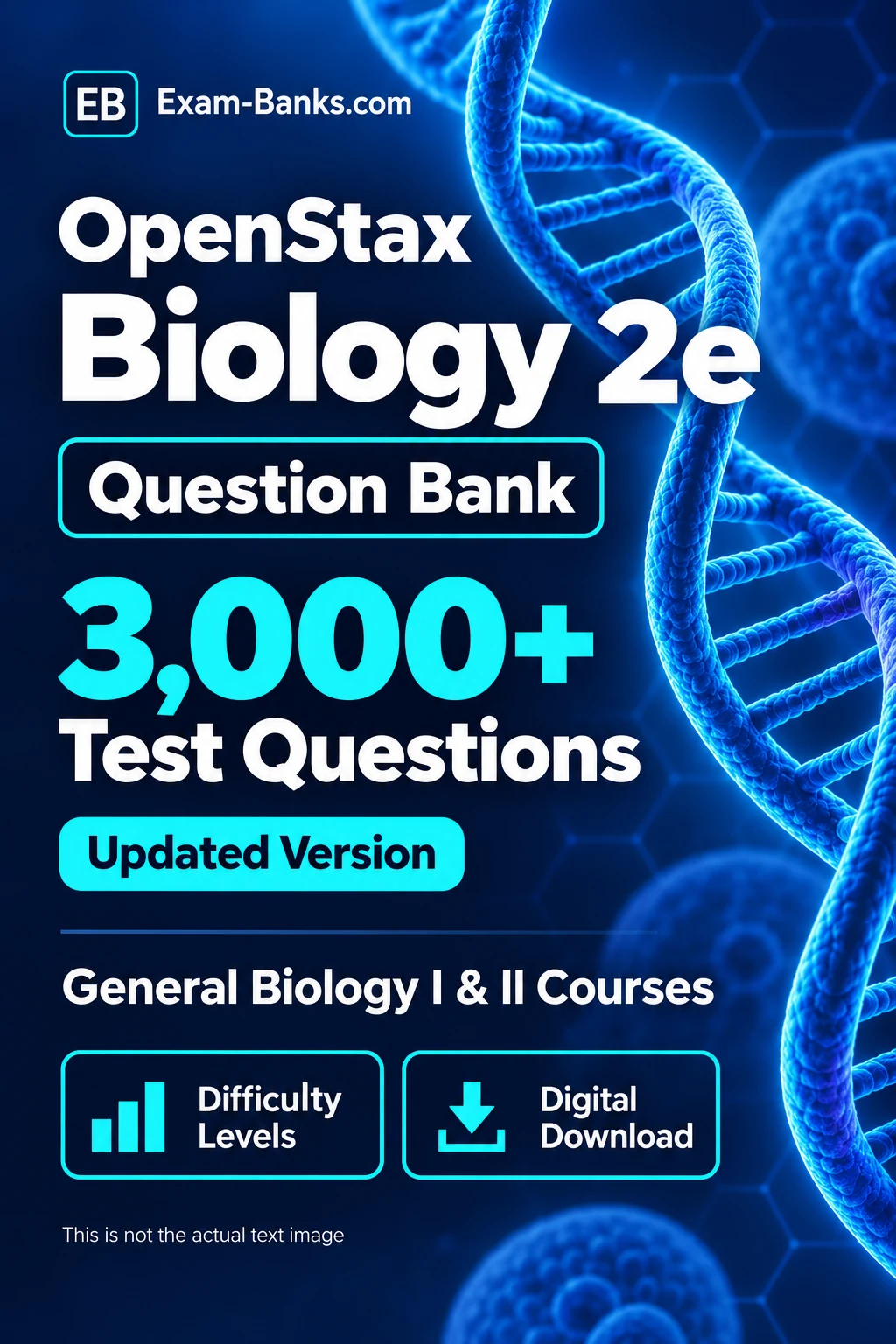
3,000+ Practice Questions with Answers for OpenStax Biology 2e
Reading a topic is one thing. Answering questions about it shows you what you understand. This OpenStax Biology 2e test bank provides you more than 3,000 questions to test yourself, identify where you need more attention, and estimate what kind of questions you can see in the exam.
Follow your course chapter by chapter, check the correct answers, and use the difficulty labels to choose your level of practice. Need help working through the textbook’s own questions? Choose the separate solutions manual with worked explanations.
What’s included
The test bank and solutions manual are sold separately.
Expanded for Biology 2e: the test bank retains the previous edition’s content and adds 50–70% more questions based on the second edition. These materials were designed, revised, and approved by a team of biology professors.
Why Choose Our OpenStax Biology 2e Test Bank?
You can find free textbook questions and chapter flashcards online, and they can provide a useful starting point for review. When comparing paid resources, look beyond the price: check the question count, chapter coverage, what comes with each question, and where the questions come from.
3,000+ questions across all 47 chapters
Get a chapter-organized collection for studying throughout your Biology 2e course.
Correct answers and difficulty levels
Check your responses and choose questions suited to the level of practice you need.
See the questions before you buy
Review 18 sample questions with answers on this page, then decide whether the format suits your study needs.
Topics covered
Review the full breadth of Biology 2e, from the chemistry inside cells to the relationships between organisms and their environments.
- Life’s chemical foundationsScientific inquiry, atoms and bonds, water, and biological molecules
- Cells, energy, and communicationCell structures, membranes, metabolism, respiration, photosynthesis, and signaling
- Inheritance and molecular geneticsCell division, meiosis, DNA, gene expression, biotechnology, and genomics
- Evolution and shared ancestryNatural selection, population change, speciation, and evolutionary relationships
- The diversity of living organismsViruses, microbes, fungi, plants, invertebrates, and vertebrates
- How plants grow and functionPlant structures, nutrient uptake, transport, and reproduction
- Animal bodies and biological systemsNutrition, movement, nervous and hormonal control, immunity, circulation, and reproduction
- Ecology and conservationPopulations, communities, ecosystems, biodiversity, and environmental change
Sample questions and answers
Read 18 sample questions from the test bank, with answer choices, correct answers, and difficulty levels shown together.
Food moves from the mouth, where the pH is approximately 7, to the stomach, where the pH is approximately 2. How does the hydrogen ion concentration change?
- decreases by 5-fold
- decreases by 100,000-fold
- decreases by 50-fold
- increases by 5-fold
- increases by 100,000-fold
- increases by 50-fold
Answer: E. increases by 100,000-fold
Which property explains why water alone cannot remove oil from animals affected by an oil spill?
- high heat of vaporization
- water is an excellent solvent
- creation of surface tension
- cohesiveness
- adhesiveness
- hydrophobic interactions
Answer: F. hydrophobic interactions
Electronegativity generally increases from left to right across the periodic table. Based on the electronegativities of the bonded atoms, which bond is nonpolar?
- HCl
- CO
- H2
- BrCl
- PF
Answer: C. H2
During blood donation screening, a finger-prick sample rises through a narrow glass tube by capillary action. Which type of bond supports the cohesive and adhesive forces responsible for this movement?
- cohesiveness
- covalent bonds
- hydrophobic interactions
- hydrogen bonds
- ionic bonds
Answer: D. hydrogen bonds
The molar mass of oxygen atoms is 16 g/mol. Three moles of oxygen atoms have a mass of _______________ grams.
Answer: 48
Before jump-starting a car, acidic corrosion is noticed on the battery terminals. Which of the following substances can neutralize the acid?
- orange juice
- baking soda
- urine
- black coffee
- lemons
Answer: B. baking soda
Which electron configuration represents a neutral magnesium (Mg) atom in its ground state?
- 1s22s22p63s23p64s23d6
- 1s22s22p63s2
- 1s22s1
- 1s22s22p4
- 1s22s22p63s1
Answer: B. 1s22s22p63s2
Why does dissolving sodium chloride (NaCl) in water delay ice formation?
- NaCl disrupts ice formation by interfering with hydrogen bonds
- NaCl contributes to the density of the ice
- NaCl has a lower freezing point
- more hydrogen bonds are formed from the addition of NaCl
Answer: A. NaCl disrupts ice formation by interfering with hydrogen bonds
Using molar masses of 16 g/mol for oxygen atoms and 1 g/mol for hydrogen atoms, four moles of hydrogen peroxide (H2O2) have a mass of _______________ grams.
Answer: 136
A wood sample still contains about 75% of its original carbon-14. Approximately how many years have elapsed?
- 2,400
- 5,750
- 8,700
- 11,400
- 17,200
Answer: A. 2,400
Approximately what percentage of the original carbon-14 remains in a wood sample after 11,200 years?
- 75%
- 50%
- 25%
- 12.5%
Answer: C. 25%
Molecules with the same chemical formula but different arrangements of atoms are called _______________.
Answer: isomers / structural isomers
Which type of bond forms through the attraction between cations and anions?
- covalent
- hydrogen
- peptide
- ionic
Answer: D. ionic
Which property makes carbon particularly important in molecules found in living organisms?
- carbon is able to form up to 4 covalent bonds
- carbon is considered inorganic
- carbon is a high energy atom
- carbon is only used to date living organisms
Answer: A. carbon is able to form up to 4 covalent bonds
_______________ is made up of atoms and occupies space.
Answer: matter
Which of these elements occur only in small amounts in living organisms? Select all that apply.
- carbon (C)
- oxygen (O)
- cobalt (Co)
- hydrogen (H)
- copper (Cu)
Answer: C. cobalt (Co); E. copper (Cu)
Subatomic particles that carry a positive charge are called _______________.
Answer: protons
Carbon-12, carbon-13, and carbon-14 are examples of which category?
- isomers
- molecules
- ions
- isotopes
- enantiomers
Answer: D. isotopes
Delivery & common questions
How will I receive my files?
Your selected resource is delivered by email after successful payment, usually within minutes. Occasionally, delivery may take up to a few hours. You receive both PDF and editable Word files.
Does $37 include both resources?
No. The test bank is $37 and the solutions manual is $37. Select the resource you want after clicking Buy Now.
Which resource should I choose?
Choose the test bank for practice questions with correct answers and difficulty levels. Choose the solutions manual for answers of the textbook’s questions.
Is this suitable for my college biology course?
This resource is aligned with OpenStax Biology 2e and is intended for college General Biology I and II study. Students using other textbooks can compare the topics above with their syllabus.
For example, General Biology I and II at Rutgers lists OpenStax Biology 2e. Course codes and assigned materials vary by institution and term; check your syllabus. This example indicates textbook use, not endorsement of this resource.
Can I preview the solutions manual here?
The sample questions above preview the test bank. The solutions manual is a separate resource. Contact us to request a solutions manual sample.
Choose the resource that fits your study needs.
$37 per resource · All chapters · Downloadable · Email delivery





Inessa –
Good for exam preparationsGood quality.
Khatia –
Great for my home study, i passed it since the online exam had around 50% same questions so well done to you guys
James –
excellent! you have practice questions for every word in the class….. Highly recommended