
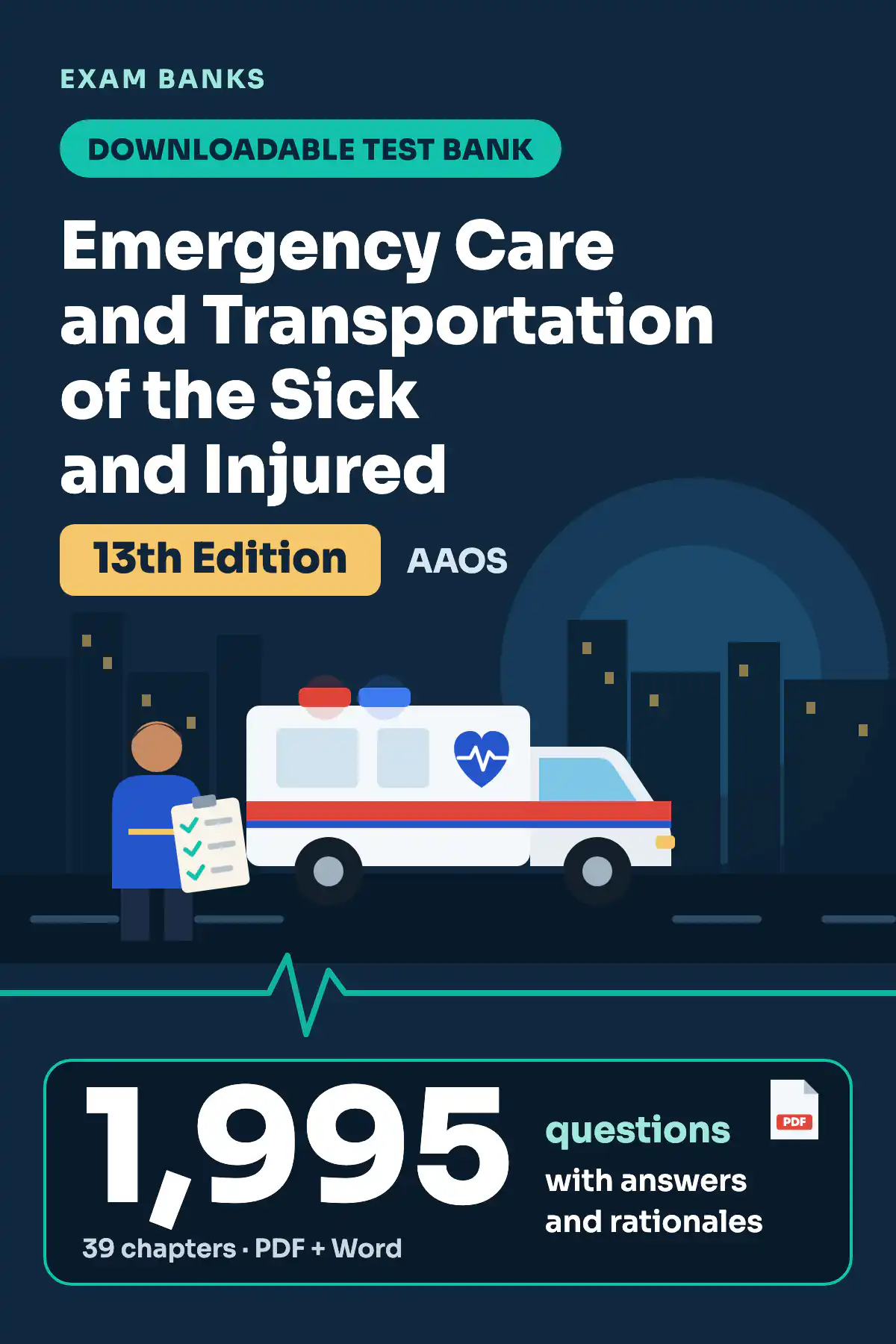
Downloadable Test Bank – Emergency Care and Transportation of the Sick and Injured 13th Edition by AAOS
$39.00
- Thirteenth Edition by AAOS, © 2027
- 1,995 practice questions, each answered with a rationale
- Questions for all 39 chapters, one file each
- Full test bank in PDF and editable Word
- Quiz yourself on this week’s chapter, then check why
- Emailed in minutes, at most a few hours
Description
Description
Practice questions with every answer explained
This test bank gives you 1,995 multiple choice practice questions built around the 39 chapters of Emergency Care and Transportation of the Sick and Injured, Thirteenth Edition. Every question has four options, one keyed answer and a short rationale, so when you miss one you see the reasoning straight away instead of hunting back through the textbook for it.
Many of the questions put you on a call. A trauma patient has pale, clammy skin, a rapid weak pulse and an enlarging abdomen. A crew has to move someone too heavy for two responders. You read the situation, choose the best action, then check the rationale to confirm why it beats the other three.
Check that it matches your textbook
The 12th edition is easy to confuse with this one. It has 41 chapters, with Pediatric Emergencies and Geriatric Emergencies as separate chapters, so its chapter numbers do not line up with the 13th edition from Chapter 24 onward. If you have the 12th edition, see the questions below. Emergency Care by Limmer and O’Keefe is a different EMT textbook.
What the download contains
- 1,995 multiple choice questions, each with four options and one best answer
- The keyed answer and a short rationale under every question
- All 39 chapters, in the same order as the textbook
- The full test bank as one PDF (422 pages) and as an editable Word file
- Rather not work from one large file? The test bank also comes split by chapter, so you can open just the chapter you need
Questions range from anatomy and terminology to assessment, treatment and EMS operations. The BLS Resuscitation chapter includes questions written to 2025 AHA guidance, such as the choking sequence that alternates back blows with abdominal thrusts.
Studying with it
Because the questions are also split into one file per chapter, you can open only the chapter your class covered this week, answer it without notes and mark the ones you miss. Each rationale names the idea behind the answer, which tells you exactly what to reread. Before a unit exam, work through the chapters on the exam list. Before a cumulative final, the full PDF lets you move across the whole book, and the Word file lets you copy questions into your own review sheets.
Try 17 practice questions from Chapter 2
These cards are questions 15 to 31 from Chapter 2, Workforce Safety and Wellness, covering nutrition, hydration, fatigue, burnout, tobacco, alcohol and infectious disease. Select Show answer on any card to check yourself. In the download, each answer is also followed by its rationale.
Question
15. After a carbohydrate-rich meal, insulin secretion increases. Which response most directly helps lower blood glucose?
- (A) Increased breakdown of liver glycogen into glucose
- (B) Increased glucose uptake by muscle cells and storage as glycogen
- (C) Increased glucose production by the liver
- (D) Reduced glucose uptake by insulin-sensitive tissues
Correct answer
Answer: B
(B) Increased glucose uptake by muscle cells and storage as glycogen
Question
16. An EMT is choosing breakfast before a long shift. Which option is the best source of fiber-rich complex carbohydrates?
- (A) Sweetened yogurt with honey
- (B) Scrambled eggs with cheese
- (C) Whole-grain oatmeal with berries
- (D) A sports drink with fruit juice
Correct answer
Answer: C
(C) Whole-grain oatmeal with berries
Question
17. An EMT compares foods for a packed lunch. Which item provides mainly protein and fat rather than starch?
- (A) Brown rice
- (B) Whole-wheat pasta
- (C) Baked potato
- (D) Cheddar cheese
Correct answer
Answer: D
(D) Cheddar cheese
Show 14 more cardsShow fewer cards
Question
18. An EMT wants to replace meat with a plant-based protein source. Which one-cup serving provides the most protein?
- (A) Cooked lentils
- (B) Raw spinach
- (C) Sliced cucumber
- (D) Shredded lettuce
Correct answer
Answer: A
(A) Cooked lentils
Question
19. An EMT wants to improve dietary fat quality while avoiding excess calorie intake. Which change best supports both goals?
- (A) Replace dietary fats with refined carbohydrates at every meal
- (B) Replace olive oil with coconut oil in the same portions
- (C) Replace butter with olive oil while keeping portions controlled
- (D) Add olive oil to meals without reducing other calorie sources
Correct answer
Answer: C
(C) Replace butter with olive oil while keeping portions controlled
Question
20. For an adult consuming 2,000 kcal per day, a saturated-fat ceiling of 10% of total energy corresponds to approximately how many grams? Fat provides 9 kcal per gram.
- (A) 11 g
- (B) 22 g
- (C) 44 g
- (D) 67 g
Correct answer
Answer: B
(B) 22 g
Question
21. After working outdoors in hot weather with little fluid intake, an EMT reports thirst, dark yellow urine, and less frequent urination. Which condition is most consistent with these findings?
- (A) Fluid overload
- (B) Hyperglycemia causing osmotic diuresis
- (C) An uncomplicated urinary tract infection
- (D) Dehydration
Correct answer
Answer: D
(D) Dehydration
Question
22. Over several months, an EMT develops persistent work-related exhaustion, cynicism toward patients, and a reduced sense of professional effectiveness. Which occupational phenomenon best fits this pattern?
- (A) Burnout
- (B) Acute stress reaction
- (C) Circadian rhythm disruption
- (D) Compassion satisfaction
Correct answer
Answer: A
(A) Burnout
Question
23. A crew must transfer a patient who exceeds the safe lifting capacity of the two available responders. The scene is stable. Which action best reduces the risk of back injury?
- (A) Complete the lift quickly to reduce time under load
- (B) Request additional personnel and appropriate patient-handling equipment
- (C) Use a back belt and proceed with the two-person lift
- (D) Rely on proper body mechanics to compensate for the excessive load
Correct answer
Answer: B
(B) Request additional personnel and appropriate patient-handling equipment
Question
24. An EMS agency schedules two consecutive 12-hour shifts for one clinician, with no break between shifts. How does this schedule compare with the EMS fatigue guideline recommending shifts shorter than 24 hours?
- (A) It meets the recommendation because each scheduled shift is 12 hours
- (B) It meets the recommendation if caffeine is available during both shifts
- (C) It meets the recommendation if the second shift has fewer calls
- (D) It does not meet the recommendation because continuous duty totals 24 hours
Correct answer
Answer: D
(D) It does not meet the recommendation because continuous duty totals 24 hours
Question
25. An EMT routinely sleeps only four hours between shifts and relies on coffee to stay alert. Which change most directly addresses the underlying sleep-related fatigue?
- (A) Increase caffeine intake before each shift
- (B) Add exercise during breaks while keeping the same sleep schedule
- (C) Protect enough off-duty time for adequate, restorative sleep
- (D) Improve meal quality while keeping the same sleep schedule
Correct answer
Answer: C
(C) Protect enough off-duty time for adequate, restorative sleep
Question
26. An EMT says smokeless tobacco cannot cause cancer because it is not inhaled. Which group of cancers is causally linked to smokeless tobacco use?
- (A) Oral, esophageal, and pancreatic cancers
- (B) Lung, kidney, and bladder cancers
- (C) Colon, thyroid, and prostate cancers
- (D) Skin, ovarian, and endometrial cancers
Correct answer
Answer: A
(A) Oral, esophageal, and pancreatic cancers
Question
27. A colleague says e-cigarettes are safe because they produce no tobacco smoke. Which response most accurately addresses the health risk?
- (A) The absence of combustion establishes long-term safety
- (B) The aerosol can contain nicotine, harmful chemicals, and particles inhaled deep into the lungs
- (C) Food-safe flavorings establish that the aerosol is safe to inhale
- (D) Using e-cigarettes alongside cigarettes reliably prevents respiratory harm
Correct answer
Answer: B
(B) The aerosol can contain nicotine, harmful chemicals, and particles inhaled deep into the lungs
Question
28. A woman reports consuming four standard alcoholic drinks during one evening and no alcohol on other days that week. Under CDC definitions, which classification is supported by this information?
- (A) Moderate drinking because the weekly total is low
- (B) Heavy weekly drinking based on four drinks in the week
- (C) Alcohol use disorder based solely on the reported quantity
- (D) Binge drinking based on four drinks on one occasion
Correct answer
Answer: D
(D) Binge drinking based on four drinks on one occasion
Question
29. CDC’s historical estimate for 2010 attributed about 77% of the economic costs of excessive alcohol use to binge drinking. Which prevention priority is best supported by this finding?
- (A) Focus prevention only on people who drink every day
- (B) Limit prevention to people with diagnosed alcohol dependence
- (C) Include reducing binge-drinking episodes as a major prevention goal
- (D) Focus prevention only on direct hospital treatment costs
Correct answer
Answer: C
(C) Include reducing binge-drinking episodes as a major prevention goal
Question
30. A patient develops tetanus after bacteria enter a contaminated puncture wound. Tetanus does not spread from person to person. How should the disease be classified?
- (A) Infectious but noncommunicable
- (B) Communicable but noninfectious
- (C) Noninfectious and noncommunicable
- (D) Both infectious and communicable
Correct answer
Answer: A
(A) Infectious but noncommunicable
Question
31. Influenza is both infectious and communicable. Which feature makes it communicable, rather than merely infectious?
- (A) It can produce systemic symptoms such as fever
- (B) It can pass from an infected person to a susceptible person
- (C) It involves replication of a pathogen within the body
- (D) It triggers an immune response in the affected person
Correct answer
Answer: B
(B) It can pass from an infected person to a susceptible person
All 1,995 questions with answers and rationales, $39.
All 39 chapters and question counts
- 1. EMS Systems and Public Health (31)
- 2. Workforce Safety and Wellness (65)
- 3. Medical, Legal, and Ethical Issues (55)
- 4. Communications and Documentation (47)
- 5. Medical Terminology (39)
- 6. The Human Body (112)
- 7. Life Span Development (49)
- 8. Lifting and Moving Patients (31)
- 9. The Team Approach to Health Care (15)
- 10. Patient Assessment (77)
- 11. Airway and Ventilation Management (63)
- 12. Principles of Pharmacology and Medication Administration (45)
- 13. Shock (47)
- 14. BLS Resuscitation (31)
- 15. Medical Overview (44)
- 16. Respiratory Emergencies (54)
- 17. Cardiovascular Emergencies (51)
- 18. Neurologic Emergencies (68)
- 19. Gastrointestinal and Urologic Emergencies (48)
- 20. Endocrine and Hematologic Emergencies (47)
- 21. Allergy and Anaphylaxis (29)
- 22. Toxicology (65)
- 23. Behavioral Health Emergencies (28)
- 24. Trauma Overview (72)
- 25. Bleeding (67)
- 26. Soft-Tissue Injuries (58)
- 27. Face and Neck Injuries (70)
- 28. Head and Spine Injuries (46)
- 29. Chest Injuries (42)
- 30. Abdominal and Genitourinary Injuries (41)
- 31. Orthopaedic Injuries (72)
- 32. Environmental Emergencies (76)
- 33. Gynecologic Emergencies (49)
- 34. Obstetrics and Neonatal Care (35)
- 35. Patients With Special Challenges (35)
- 36. Transport Operations (35)
- 37. Vehicle Extrication and Special Rescue (20)
- 38. Incident Management (66)
- 39. Terrorism Response and Disaster Management (70)
Delivery and refunds
After payment, the files are sent to the email address on your order, usually within a few minutes and at most a few hours. You receive the full test bank as a PDF and a Word file, plus a separate question file for each of the 39 chapters.
If the files cannot be delivered, or what you receive is not the test bank described on this page, you get a refund. Once the correct files have been delivered, the sale is final.
$39 for the complete 13th edition test bank.
Questions before you buy
I have the 12th edition. How do I use this test bank?
Chapters 1 to 23 line up directly. From Chapter 24 on, match chapters by title; pediatric and geriatric questions are spread through the test bank.
Does every question come with an answer?
Yes. All 1,995 questions have the correct letter marked, and each one is followed by a short rationale explaining why that option is the best answer.
What kind of questions are in the test bank?
All of them are multiple choice with four options and one best answer. Many describe a short patient or crew situation and ask what to do or what it means; others check definitions, anatomy and terminology from the chapter.
Can I study one chapter at a time?
Yes. The questions for each of the 39 chapters also come as a separate PDF file, so you can work through the chapter your class is on without scrolling through the whole test bank. The complete test bank in PDF and Word is included as well.
How and when will I get the files?
By email, to the address you use at checkout. Delivery usually takes a few minutes and at most a few hours after payment.


Kevin –
Fantastic
Tyler –
Good test bank to help in exams
taline –
thanks