
Description
Prepare for your sociology midterm with explained answers
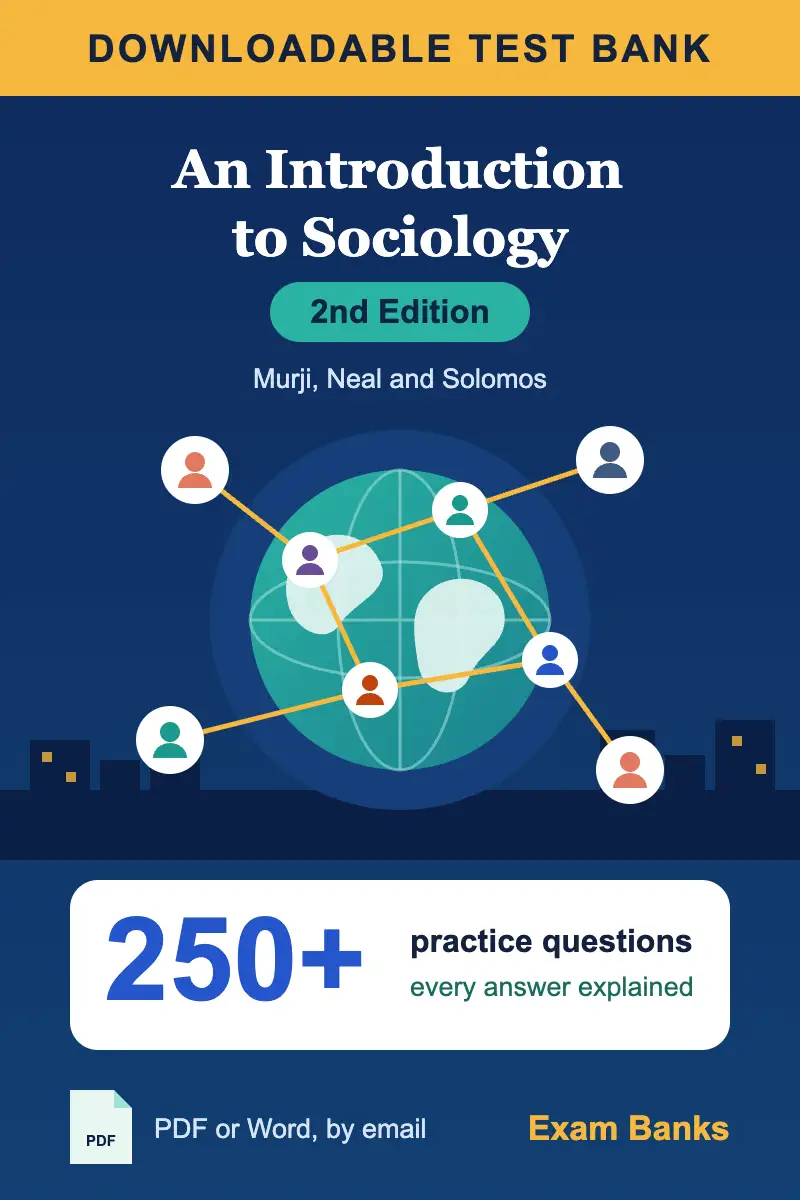
This test bank gives you 250+ multiple choice practice questions for the 2nd edition of An Introduction to Sociology, covering 22 of its 29 chapters, from What is Society to Science and Technology. Every answer comes with a one sentence explanation that states the textbook’s term, theorist or finding, so a question you get wrong still shows you the point you need for the exam. Try the 8 sample practice questions below; they cover digital society topics from Chapter 20, Digital Sociologies.
Is this your book?
An Introduction to Sociology, 2nd edition (2026)
- Authors
- Karim Murji, Sarah Neal and John Solomos
- Publisher
- SAGE Publications, London, April 2026, 29 chapters
- ISBN
- 9781036206659 (paperback), 9781036206666 (hardback)
- 1st edition
- You can use this test bank with the 1st edition (SAGE, 2022), ISBN 9781526492791 (paperback) or 9781526492807 (hardback). Its chapters are numbered differently, so check the topic titles below.
What the explained answers can do for your sociology exams
- Learn the point, not just the letter. The explanation under each answer is a short sentence you can reread before a test, for example in Health: the process by which human conditions are defined as medical problems is called medicalization.
- Tell the theorists apart. 30 practice questions ask which theorist, researcher or academic is behind an idea or study: Durkheim, Weber and Marx in the classical chapters, Bourdieu on capital in Class, Michael Mann on despotic power in War and Political Violence, and Burawoy and Gans in Public Sociology.
- Remember the findings and figures. 13 practice questions ask for a number, date or percentage from the textbook, such as the life expectancy gap in Public Health England data or the share of the world’s population living outside their country of birth. Several use UK data, because the textbook is published in the UK.
- Practice the chapters your class assigns. The practice questions are grouped by chapter topic, so you can work through the topics on your class schedule one at a time.
Try 8 sample practice questions
These samples cover digital society topics from Chapter 20, Digital Sociologies. They are written as short scenarios. Most practice questions in the full test bank ask about a term, theorist or finding directly and come with an explanation. Pick your answer, then press Show answer.
1. A workplace app rewards speed but overlooks employee well-being. What does this design choice illustrate about technology?
- a) Technologies develop independently of social priorities.
- b) Technologies affect all users in the same way.
- c) Technologies reflect values and assumptions embedded in their design.
- d) Technologies become neutral once they are widely adopted.
Answer: c) Technologies reflect values and assumptions embedded in their design.
2. A welfare agency uses interconnected databases and automated assessments to monitor low-income households and control access to assistance. Which concept describes this form of poverty management?
- a) Digital literacy
- b) Technological convergence
- c) The digital divide
- d) The digital poorhouse
Answer: d) The digital poorhouse
3. An organisation analyses records of previous equipment failures to estimate which machines are most likely to break down next. What type of analytics is it using?
- a) Descriptive analytics
- b) Predictive analytics
- c) Diagnostic analytics
- d) Prescriptive analytics
Answer: b) Predictive analytics
Show 5 more sample practice questionsShow fewer sample practice questions
4. An online service allows people to exchange content while its operators set participation rules and determine how interactions are organised. What is this type of digital environment called?
- a) A platform
- b) A database
- c) A communication protocol
- d) A computer operating system
Answer: a) A platform
5. Banking, education, and public services increasingly depend on online systems. How does this illustrate the infrastructuralization of the Internet?
- a) Internet access is becoming equally available to everyone.
- b) Physical networks are being replaced entirely by wireless connections.
- c) Digital services are becoming essential foundations of everyday activities.
- d) Users are gaining complete control over how online services operate.
Answer: c) Digital services are becoming essential foundations of everyday activities.
6. Students in one community have reliable broadband and suitable computers, while students in another lack both. Which concept best describes this inequality?
- a) The digital divide
- b) Algorithmic bias
- c) Technological convergence
- d) Platform governance
Answer: a) The digital divide
7. A commentator argues that technological inventions determine how society develops, with people largely adapting to changes imposed by those inventions. Which viewpoint does this represent?
- a) The social construction of technology
- b) Participatory design
- c) Social determinism
- d) Technological determinism
Answer: d) Technological determinism
8. A researcher investigates how workplace culture influences the design of digital tools and how those tools subsequently change working practices. Which perspective best captures this approach?
- a) A purely technical perspective focused on system performance
- b) A socio-technological perspective examining relationships between technology and social practices
- c) A technological determinist perspective treating technology as the sole driver of change
- d) An economic perspective focused exclusively on financial costs
Answer: b) A socio-technological perspective examining relationships between technology and social practices
Ready to practice 22 chapters of the 2nd edition?
Chapters covered
- Chapter 2: What is Society
- Chapter 3: Global Sociology and Our Interconnected World
- Chapter 4: Classical Sociologies
- Chapter 5: Contemporary Social Theory
- Chapter 6: Public Sociology
- Chapter 7: Class
- Chapter 8: Gender
- Chapter 10: Race
- Chapter 11: Age
- Chapter 13: Families and Households
- Chapter 14: Work
- Chapter 15: Health
- Chapter 16: Education
- Chapter 17: Religion
- Chapter 18: Crime and Deviance
- Chapter 19: Cultures & Consumption
- Chapter 20: Digital Sociologies
- Chapter 22: War and Political Violence
- Chapter 24: Social Movements
- Chapter 25: Migrations
- Chapter 26: Climate Change and the Environment
- Chapter 27: Science and Technology
The test bank also has practice questions on research methods (qualitative, quantitative, visual and digital methods), intimacies and relationships, and sociology as a science.
What you get
Included
- 250+ multiple choice practice questions, four options each
- The correct answer and a one sentence explanation for every question
- 22 of the 29 chapters in the 2nd edition, plus the research methods topics above
- PDF or Word files in a ZIP
Not included
- The textbook, in print or as an eBook
- True or false or essay questions
Delivery and refunds
Delivery: sent to your email after payment, as PDF or Word files in a ZIP.
Refunds: If the file you receive is not the An Introduction to Sociology test bank described here, or it cannot be delivered, you get a refund. Once the correct files are delivered, the sale is final.
Seller: Exam Banks is an independent seller and is not affiliated with SAGE or the authors. Questions before you buy: info@exam-banks.com
250+ explained practice questions for the 2nd edition, ready for your next sociology exam.
Related test banks
- Introduction to Sociology test bankGiddens Different book, same title
- Introduction to Sociology test bankGeorge Ritzer, 6th edition Different book, same title
- Imagining Society: An Introduction to Sociology test bankCatherine Corrigall-Brown, 2nd edition Different book, same title
- Being Sociological test bankSteve Matthewman Same course
- Browse all sociology test banks



Reviews
Be the first to review this product.