
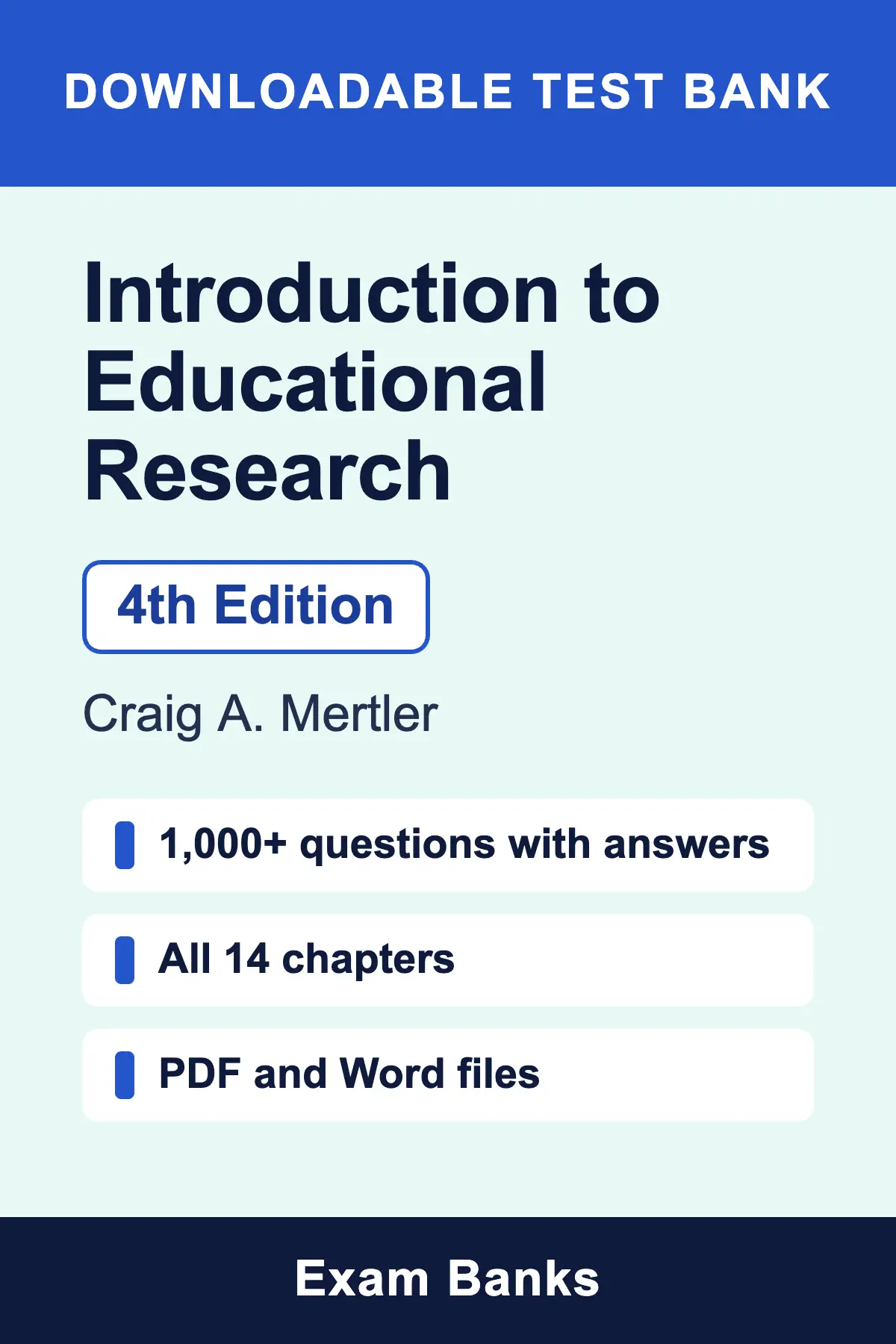
Downloadable Test Bank – Introduction to Educational Research, 4th Edition (Mertler)
$36.00
- 4th edition, Craig A. Mertler (Sage, 2024)
- Over 1,000 questions, every answer included
- All 14 chapters, one section per chapter
- Multiple choice and true or false
- Scenario items: name the design, spot the variable
- PDF and Word, emailed within minutes to hours
Description
Description
A practice question bank for the 4th edition of Introduction to Educational Research by Craig A. Mertler (Sage, 2024). It follows the book chapter by chapter, so you can test yourself on each chapter before the quiz or exam that covers it. It is not the textbook and not a free PDF: it is a paid set of exam style questions with an answer for every one.
Check that this matches your textbook
Introduction to Educational Research, 4th Edition
- Author
- Craig A. Mertler
- Publisher
- Sage Publications
- Published
- November 2024
- Paperback ISBN
- 9781071903155
- eBook ISBN
- 9781071903179
- Loose leaf ISBN
- 9781071903209
- Sage Vantage ISBN
- 9781071968413
Compare the ISBN on the back cover or copyright page of your book with this list. Sage’s student website shows the same book under the name Introduction to Education Research, so either title points to this edition.
What the questions ask you to do
The samples below show the style: short research scenarios where you decide what is going on, instead of recalling a definition word for word.
- Name the design. A teaching strategy is varied under controlled conditions; working hours and stress are recorded as they are. You decide which is experimental and which is nonexperimental (samples 5 and 11).
- Find the manipulated variable in a study with random assignment (sample 6).
- Avoid the tempting shortcut. Wrong options include picking only participants who support the hypothesis, or treating a correlation as proof of cause (samples 2 and 12).
- Match evidence to the approach: open ended interviews and coded themes for qualitative work, rating scales for quantitative work, and both together for mixed methods (samples 14, 16 and 20).
This is the kind of judgment Chapters 6 to 9 build, where the book sets qualitative, quantitative, mixed methods and action research side by side, and Chapter 13, where results have to be read with care.
Try 20 sample questions
These questions come from the test bank itself. Choose your answer, then press Show answer to check it.
1. Which decision is an essential part of planning a research study before data collection begins?
- A. Determining which findings will support the hypothesis
- B. Selecting the procedures and instruments for collecting evidence
- C. Finalizing the interpretation of the results
- D. Establishing the conclusions that will appear in the report
Answer: B. Selecting the procedures and instruments for collecting evidence
2. A researcher plans to investigate university students’ study habits. Which action best demonstrates appropriate preparation for data collection?
- A. Drafting conclusions based on previous studies
- B. Selecting only students whose experiences support the hypothesis
- C. Choosing a statistical test after deciding which results to report
- D. Defining the variables and selecting suitable measurement tools
Answer: D. Defining the variables and selecting suitable measurement tools
3. Research conclusions should be evaluated in relation to the evidence, conditions, and context of the study and may be revised when new evidence emerges.
- A. True
- B. False
Answer: A. True
Show 17 more sample questionsHide the extra questions
4. Two well-designed studies report different findings about the effectiveness of the same teaching strategy. One examines primary school students, while the other examines university students. What is the most appropriate initial response?
- A. Examine whether differences in participants and study conditions account for the findings
- B. Accept the more recently published study as universally applicable
- C. Conclude that neither study provides useful evidence
- D. Assume that the study reporting the smaller effect contains an error
Answer: A. Examine whether differences in participants and study conditions account for the findings
5. A researcher deliberately varies an instructional strategy to evaluate its effect on student performance under controlled conditions. Which research design does this describe?
- A. Correlational
- B. Descriptive
- C. Experimental
- D. Ethnographic
Answer: C. Experimental
6. Participants are randomly assigned to receive either a new memory-training program or a comparison activity. Which variable is being manipulated?
- A. Participants’ initial memory ability
- B. The activity participants receive
- C. Participants’ final memory scores
- D. The relationship between age and memory
Answer: B. The activity participants receive
7. Which set of characteristics best describes the standards that systematic scientific inquiry seeks to achieve?
- A. Consistency with expectations and freedom from revision
- B. Rapid conclusions and minimal procedural documentation
- C. Reliance on expert opinion and selective use of evidence
- D. Reliable measurement, accurate observation, and minimized bias
Answer: D. Reliable measurement, accurate observation, and minimized bias
8. A research team uses calibrated instruments, standardized procedures, and assessors who do not know participants’ group assignments. What is the main purpose of these measures?
- A. To guarantee that the hypothesis will be supported
- B. To eliminate all uncertainty from the findings
- C. To improve measurement quality and reduce potential bias
- D. To make replication by other researchers unnecessary
Answer: C. To improve measurement quality and reduce potential bias
9. Scientific investigations must always proceed through an identical sequence of steps without revisiting earlier decisions.
- A. True
- B. False
Answer: B. False
10. During a pilot study, researchers discover that several survey items are unclear. They revise the items and test them again before launching the main study. What does this illustrate?
- A. The iterative refinement of research procedures
- B. The replacement of systematic inquiry with personal judgment
- C. The manipulation of findings to support a hypothesis
- D. The abandonment of the original research problem
Answer: A. The iterative refinement of research procedures
11. Investigators examine the association between employees’ working hours and reported stress. They record existing conditions without assigning work schedules or introducing an intervention. How should this study be classified?
- A. Experimental
- B. Quasi-experimental
- C. Nonexperimental
- D. Grounded theory
Answer: C. Nonexperimental
12. A survey finds that students who report longer study hours also tend to earn higher grades. Why is this finding insufficient to establish that additional study time causes higher grades?
- A. Surveys cannot identify relationships between variables
- B. Grades cannot be examined using quantitative methods
- C. A positive relationship rules out alternative explanations
- D. Other factors may influence both study time and academic performance
Answer: D. Other factors may influence both study time and academic performance
13. Numerical measurement is the principal form of evidence used in qualitative research.
- A. True
- B. False
Answer: B. False
14. A researcher wants to understand how newly qualified nurses experience their transition into professional practice. Which data source is most appropriate for a qualitative investigation?
- A. Monthly counts of completed shifts
- B. Scores from a standardized clinical knowledge test
- C. Detailed accounts collected through open-ended interviews
- D. Numerical ratings of job satisfaction alone
Answer: C. Detailed accounts collected through open-ended interviews
15. When researchers analyze participants’ detailed accounts of their experiences, they are primarily working with ______ data.
- A. narrative
- B. numerical
- C. physiological
- D. experimental
Answer: A. narrative
16. A researcher reviews interview transcripts, assigns codes to meaningful passages, and groups related codes into themes. What is the primary purpose of this process?
- A. To convert every response into a standardized test score
- B. To establish causation through manipulation of variables
- C. To calculate the statistical significance of group differences
- D. To identify patterns of meaning across participants’ accounts
Answer: D. To identify patterns of meaning across participants’ accounts
17. Qualitative research designs are conventionally classified into experimental and nonexperimental categories.
- A. True
- B. False
Answer: B. False
18. Which research approach is most appropriate for examining the shared meanings and everyday practices of a cultural group through sustained observation and engagement?
- A. Randomized controlled trial
- B. Correlational research
- C. Ethnography
- D. Quasi-experimental research
Answer: C. Ethnography
19. Qualitative and quantitative approaches can provide different but complementary understandings of the same phenomenon because they examine different forms of evidence.
- A. True
- B. False
Answer: A. True
20. A hospital measures patient satisfaction using a structured rating scale and conducts interviews to explore the reasons behind patients’ ratings. What is the main advantage of combining these approaches?
- A. It ensures that the two sources of evidence will produce identical findings
- B. It connects measurable patterns with detailed explanations of patients’ experiences
- C. It removes the need to assess the quality of either data source
- D. It establishes that hospital practices caused the reported satisfaction levels
Answer: B. It connects measurable patterns with detailed explanations of patients’ experiences
Chapters covered
All 14 chapters of the 4th edition, with a separate section of questions for each chapter.
- Chapter 1: What Is Educational Research?
- Chapter 2: Overview of the Educational Research Process
- Chapter 3: Identifying a Research Problem
- Chapter 4: Ethics in Educational Research
- Chapter 5: Reviewing Related Research Literature
- Chapter 6: Qualitative Research Methods
- Chapter 7: Quantitative Research Methods
- Chapter 8: Mixed-Methods Research
- Chapter 9: Action Research
- Chapter 10: Writing a Research Proposal
- Chapter 11: Qualitative Data Collection and Analysis
- Chapter 12: Quantitative Data Collection
- Chapter 13: Quantitative Data Analysis
- Chapter 14: Writing a Final Research Report
What you get
Included
- Over 1,000 questions, each with its correct answer
- Multiple choice and true or false questions
- A PDF file for reading and printing
- A Word file you can edit, to hide the answers or copy questions into your own practice quizzes
Not included
- The textbook itself, in print or as an eBook
- Sage Vantage access or codes
- Short answer or essay questions
- Answers to the book’s end of chapter activities
Delivery and refunds
Delivery: sent to your email, usually within a few minutes to a few hours of payment.
Refunds: If the file you receive is not the 4th edition test bank described here, or it cannot be delivered, you get a refund. Otherwise sales of digital files are final.
Seller: Exam Banks is an independent seller and is not affiliated with Sage or the author. Questions before you buy: info@exam-banks.com





sarah –
helpful material