
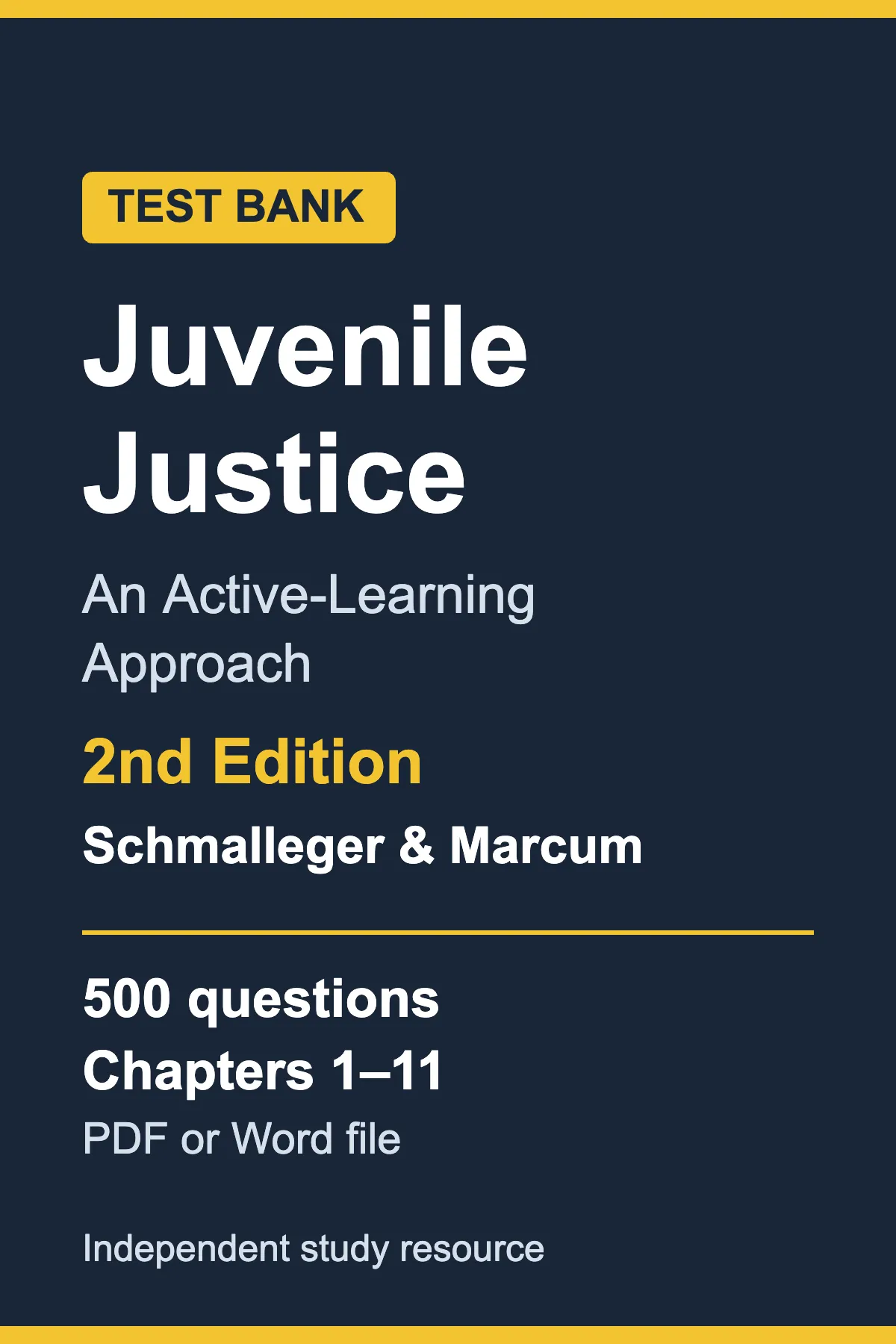
Downloadable Test Bank – Juvenile Justice Schmalleger 2e
$36.00
- For Juvenile Justice: An Active-Learning Approach, 2nd edition (SAGE, 2023)
- Textbook by Schmalleger and Marcum
- 500 practice questions with answers
- Covers Chapters 1–11
- Delivered by email as a PDF or Word file
- Check the chapter list and try the sample questions below before you buy
Description
Description
What this Juvenile Justice Schmalleger test bank includes
This test bank is written for Juvenile Justice: An Active-Learning Approach, 2nd edition, by Frank Schmalleger and Catherine D. Marcum (SAGE, 2023). It gives you 500 practice questions with answers, organised by the book’s 11 chapters, so you can quiz yourself one chapter at a time before a test.
- Textbook
- Juvenile Justice: An Active-Learning Approach
- Edition
- 2nd edition (2023)
- Authors
- Frank Schmalleger and Catherine D. Marcum
- Questions
- 500, with answers
- Question types
- Including multiple-choice and true/false
- Coverage
- Chapters 1–11 (all four parts)
- File format
- PDF or Word
- Delivery
- By email, generally within 8 hours of payment
- Price
- $36.00
Check it matches your textbook
Compare these chapter titles with your book’s table of contents. If they match, this is the right test bank. If your book is a different edition, or the chapters do not match, contact us with your book’s details before ordering.
Part I: Understanding Juvenile Justice and Delinquency
- Chapter 1. History of the Juvenile Justice System
- Chapter 2. Measurement of Juvenile Crime
- Chapter 3. Theories of Delinquency
Part II: Navigating the Juvenile Justice System
- Chapter 4. Juveniles and the Police
- Chapter 5. The Juvenile Court System
- Chapter 6. The Juvenile Corrections System
Part III: Juvenile Behaviors
- Chapter 7. Juveniles and Gangs
- Chapter 8. Juveniles and Violence
- Chapter 9. Juveniles and Cybercrime
- Chapter 10. Juvenile Drug Use
Part IV: Moving Forward
- Chapter 11. Effective Programs for Juveniles
Try the sample questions
These are real questions from the test bank. Choose “Show answer” on any card to check yourself. The essay prompts are open-ended, so the file gives no single model answer for them.
1. Which country developed legal standards recognizing that children younger than seven should not be held criminally responsible?
- A. America
- B. Spain
- C. France
- D. England
Answer: D
D. England
2. Which act would be classified as delinquency, rather than a status offense, when committed by a juvenile?
- A. Missing school without permission
- B. Violating a youth curfew
- C. Consuming alcohol while underage
- D. Committing simple assault
Answer: D
D. Committing simple assault
3. Which landmark ruling helped establish due process protections for juveniles facing transfer to adult criminal court?
- A. Miller v. Alabama
- B. Graham v. Florida
- C. Kent v. United States
- D. Commonwealth v. Fisher
Answer: C
C. Kent v. United States
4. In which 1870 case did the Illinois Supreme Court affirm parents’ right to raise their children without unwarranted government interference?
- A. People v. Turner
- B. Kent v. United States
- C. Ex Parte Crouse
- D. Commonwealth v. Fisher
Answer: A
A. People v. Turner
5. Which of the following juvenile court terms corresponds most closely to a sentence involving institutional placement in adult criminal proceedings?
- A. Adjudication
- B. Hearing
- C. Commitment
- D. Petition
Answer: C
C. Commitment
6. Which document in juvenile court serves a function comparable to an indictment in adult criminal court?
- A. Petition
- B. Commitment
- C. Custody
- D. Adjudication
Answer: A
A. Petition
Show 8 more sample questions
7. Adjudication in juvenile court refers to the punishment imposed and is equivalent to a sentence in adult criminal court.
- A. True
- B. False
Answer: B
B. False
8. Which federal agency was created in 1912 and became involved in juvenile justice matters, including juvenile probation?
- A. Federal Bureau of Investigation
- B. U.S. Children’s Bureau
- C. Federal Bureau of Parole and Probation
- D. U.S. Child Protective Services
Answer: B
B. U.S. Children’s Bureau
9. Explain why houses of refuge were established. Describe the living conditions and daily routines within these institutions, and discuss what eventually happened to them.
Answer: Answers vary.
10. Explain the origins, objectives and activities of the child saver movement.
Answer: Answers vary.
11. When legal standards governing children were limited, courts could decline to impose sanctions by exercising which option?
- A. Nullification
- B. Voidance
- C. Deferment
- D. Annulment
Answer: A
A. Nullification
12. Explain the distinction between status offenses and delinquent acts. Include at least one example of each.
Answer: Answers vary.
13. Evaluate the importance of Kent v. United States. How did the decision influence procedures and protections within the juvenile justice system?
Answer: Answers vary.
14. A boy admitted to an American house of refuge during the 1830s would most likely have had which background or experience?
- A. Being confined alongside adult offenders
- B. Living and working on a farm
- C. Being placed in an assigned family group
- D. Having previously lived in a large city
Answer: D
D. Having previously lived in a large city
How to study with it
Work through one chapter at a time. Answer the questions before you look at the key, mark the ones you miss, and go back to that section of the textbook or your class notes. Come back to the hard questions a few days later. These questions are for practice: we do not promise that any of them will appear on your exam.
Delivery, format and refunds
- You receive the test bank as a PDF or Word file, sent as an email attachment or a download link.
- Delivery usually takes a few minutes to a few hours, generally within 8 hours of payment. Check your spam folder and make sure your email address at checkout is correct.
- You can get a refund only if your files have not been delivered yet. Once the files are delivered, we cannot offer a refund.
- Have a question before buying? Read our test bank FAQ or contact our support team.
Other juvenile justice test banks
Is your course using a different book? See the Juvenile Justice test bank for Cox, 10th edition, the Juvenile Delinquency test bank by Bates, or all of our criminology test banks.
Exam Bank is an independent study resource. We are not affiliated with or endorsed by SAGE Publishing.




Reviews
Be the first to review this product.