
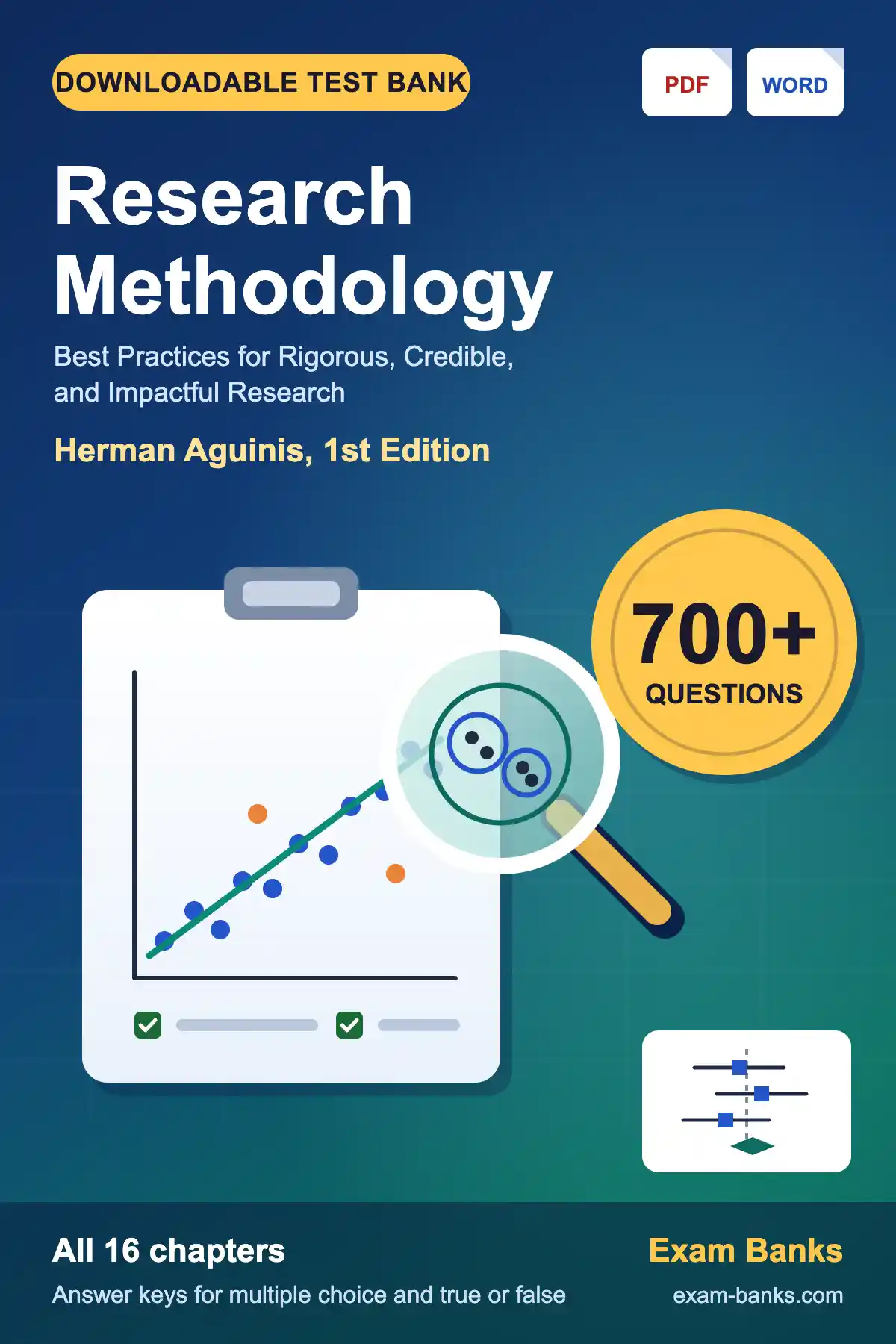
Downloadable Test Bank – Research Methodology: Best Practices for Rigorous, Credible, and Impactful Research, 1st Edition (Aguinis)
$36.00
- 1st edition, Herman Aguinis (SAGE, 2025)
- Over 700 practice questions across all 16 chapters
- About 45 practice questions for each chapter
- Answer keys for multiple choice and true or false
- 10 open questions per chapter for written practice
- PDF and Word files, sent by email
Description
Description
Practice for every Aguinis chapter your class assigns
Aguinis wrote Research Methodology so instructors can assign the chapters they need, which means your reading list may jump from ethics to multilevel modeling to qualitative research. This test bank follows the same 16 “How to” chapters, with its own set of about 45 practice questions for each one: 25 multiple choice, 10 true or false and 10 open questions. You can practice exactly the chapters on your syllabus and leave the rest. Try the 10 sample practice questions below.
Is this your book?
Research Methodology: Best Practices for Rigorous, Credible, and Impactful Research
- Author
- Herman Aguinis, The George Washington University
- Publisher
- SAGE, copyright 2025, 616 pages
- Edition
- 1st edition, the only edition so far
- ISBN
- 9781071871942 (paperback), 9781071871928 (eBook)
- Chapters
- 16, from the methodological landscape to research impact
Research Methodology by Ranjit Kumar or by C. R. Kothari
Other widely used books are also called Research Methodology. This test bank does not cover them; check that your cover names Aguinis.
What the chapter sets can do before a methods exam
- Practice only what you were assigned. Every chapter has its own set of practice questions of the same build, so a class that covers six chapters gives you six complete sets, not a mixed pile to sort through.
- Know the book’s own terms cold. Most multiple choice practice questions ask directly about the terms and recommendations in the chapter, for example error versus interesting outliers and HARKing in Chapter 8, or the TMGT effect in Chapter 9. Your practice uses the same words as your reading.
- Rehearse written answers. Each chapter ends with 10 open practice questions, such as “Describe a full mediation model” or how you would avoid a moderation problem in your own research. They have no model answers, so you write your own and compare it with the chapter.
- Cover the four analysis chapters. Regression, multilevel modeling, meta-analysis and the advanced techniques chapter (Chapters 9 to 12) have 180 practice questions between them.
Try 10 sample practice questions
Pick your answer, then press Show answer.
10. A researcher summarizes the essential study information in a brief, understandable format before inviting people to participate. Which ethical right does this practice primarily support?
- A. Having identifying information protected from unauthorized disclosure
- B. Making a voluntary, informed decision about participation
- C. Controlling access to one’s personal life
- D. Receiving an explanation after the study has concluded
Answer: B — Informed consent
11. Research records identify participants through assigned codes rather than their actual names. What is the primary ethical purpose of this practice?
- A. To explain the study’s purpose after participation ends
- B. To establish that participation was freely chosen
- C. To prevent intrusion into participants’ personal lives
- D. To protect the confidentiality of participants’ identities
Answer: D — Confidentiality
12. Which research situation is identified as requiring participant consent?
- A. A study involving human participants that receives federal financial support
- B. An investigation based on observing behavior in its everyday setting
- C. An analysis of information already held in archival records
- D. A questionnaire that collects responses without identifying respondents
Answer: A — Federally funded research
Show 7 more sample questionsShow fewer sample questions
13. Which researcher action violates a participant’s right to control the personal information they receive?
- A. Explaining relevant study details before the participant decides whether to enroll
- B. Giving approved recipients access to information they are authorized to review
- C. Communicating personal information despite the participant’s expressed wish not to receive it
- D. Showing the participant information used to make decisions affecting them
Answer: C — Providing unwanted personal information
14. When conducting research within a school, workplace, or community organization, which action most directly demonstrates ethical responsibility toward participants?
- A. Announcing an intention to follow the study’s principles
- B. Safeguarding participants’ physical and psychological welfare throughout the research
- C. Treating the clarification of research objectives as the only ethical priority
- D. Assuming that disagreements with the host organization have no ethical implications
Answer: B — Protecting participants’ well-being
15. After commissioning an evaluation, an organization asks the researcher to exclude evidence that could harm its public image. What ethical violation would occur if the researcher complied?
- A. Presenting another person’s work without appropriate acknowledgment
- B. Making research evidence available for further examination
- C. Assigning publication credit inaccurately
- D. Withholding unfavorable research evidence from the reported findings
Answer: D — Censoring data
16. Under the data-retention recommendation, what period should elapse after publication before study records are considered for disposal?
- A. Twelve months
- B. A decade
- C. Five years
- D. Two years
Answer: C — Five years
17. Which behavior presents an ethical concern when recruiting research participants through MTurk?
- A. Giving false details about personal characteristics to meet eligibility requirements
- B. Joining a study without previous exposure to similar research
- C. Considering the researcher’s treatment of workers to be fair
- D. Reducing involvement in online communities of MTurk workers
Answer: A — Self-misrepresentation
18. A researcher posts an MTurk task that cannot be completed using accessibility tools required by some workers with disabilities. Which ethical challenge does this most directly represent?
- A. Workers concealing or falsifying their identities
- B. Workers having prior experience with similar studies
- C. Expansion of online networks where workers exchange information
- D. Workers perceiving the researcher’s participation arrangements as unfair
Answer: D — Perceived researcher unfairness
19. A research team wants to detect procedural problems before implementing a study with a large sample. Which action would provide the most useful preliminary assessment?
- A. Inserting questions intended to detect inattentive responding
- B. Running a small-scale trial of the study procedures
- C. Checking whether prospective participants satisfy eligibility criteria
- D. Preparing the description and instructions for the online research task
Answer: B — Pilot testing
Ready to practice the chapters on your syllabus?
Chapters covered
- Chapter 1: How to Understand the Current Methodological Landscape44 questions
- Chapter 2: How to Conduct Ethical Research45 questions
- Chapter 3: How to Make Contributions to Theory45 questions
- Chapter 4: How to Plan Your Research45 questions
- Chapter 5: How to Collect Your Sample Using Surveys and Other Means45 questions
- Chapter 6: How to Measure Your Variables45 questions
- Chapter 7: How to Design and Conduct Experimental Research45 questions
- Chapter 8: How to Prepare Your Data for Analysis45 questions
- Chapter 9: How to Conduct Quantitative Analysis, Part I: Regression-based Approaches45 questions
- Chapter 10: How to Conduct Quantitative Analysis, Part II: Multilevel Modeling45 questions
- Chapter 11: How to Conduct Quantitative Analysis, Part III: Meta-analysis45 questions
- Chapter 12: How to Conduct Quantitative Analysis, Part IV: Advanced Techniques45 questions
- Chapter 13: How to Conduct Qualitative Research45 questions
- Chapter 14: How to Report Your Results45 questions
- Chapter 15: How to Improve the Transparency, Reproducibility, and Replicability of Your Research45 questions
- Chapter 16: How to Enhance the Impact of Your Research45 questions
What you get
Included
- Over 700 practice questions across all 16 chapters
- 25 multiple choice, 10 true or false and 10 open questions per chapter
- Answer keys for every multiple choice and true or false question
- A PDF file and a Word file
Not included
- Model answers for the open questions
- The textbook, in print or as an eBook
- SAGE lecture slides
Delivery and refunds
Delivery: sent to your email as PDF and Word files after payment.
Refunds: If the file you receive is not the Research Methodology test bank described here, or it cannot be delivered, you get a refund. Once the correct files are delivered, the sale is final.
Seller: Exam Banks is an independent seller and is not affiliated with SAGE or the author. Questions before you buy: info@exam-banks.com
Ready to order the Research Methodology test bank?
Related test banks
- Performance Management test bankHerman Aguinis, 5th edition Same author
- Business Research Methods test bankBryman, 3rd edition Same course
- Business Research Methods test bankBell, 6th edition Same course
- Qualitative Inquiry and Research Design test bankCreswell, 5th edition Same course
- Browse all psychology test banks




Sid –
Nice collection of questions