Availability: In Stock

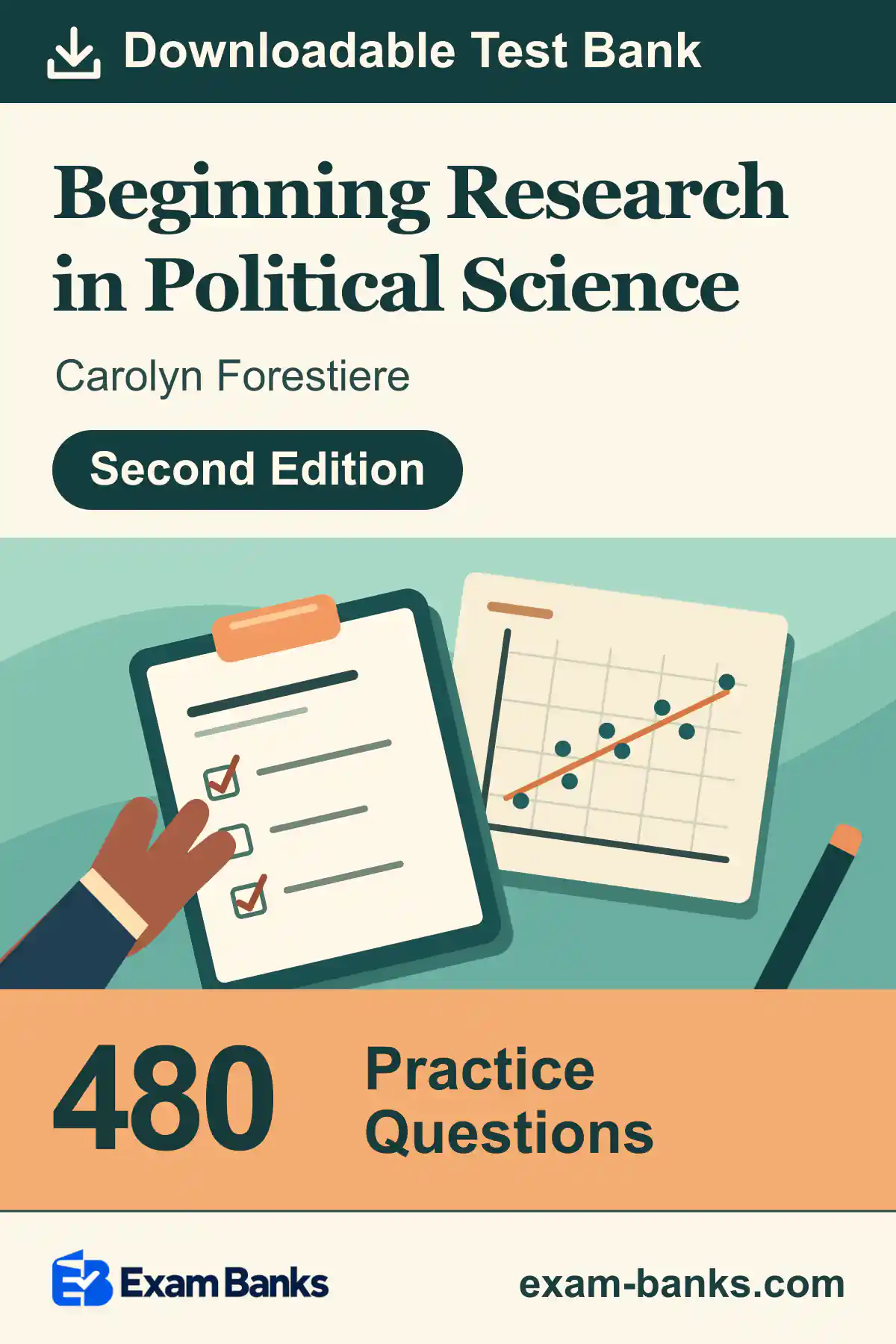
Downloadable Test Bank – Beginning Research in Political Science, Second Edition, by Carolyn Forestiere

$36.00

  • 480 practice questions with a correct answer for each
  • Open the test bank to the chapter you’re studying
  • 12 Word documents in one ZIP file
  • Email delivery, usually within a few minutes to a few hours after payment
Buy Now

Description

Practice questions for all 12 chapters of Beginning Research in Political Science

Each chapter in the test bank gives you a separate set of practice questions to use alongside the assigned reading. When you study measurement, you can practice choosing a survey question that measures a political concept. When you reach regression, you can use a coefficient to predict how an outcome changes. The correct answer appears below each question so you can check your choice as you go.

Does this match my textbook?

This test bank accompanies Carolyn Forestiere’s Beginning Research in Political Science, second edition, published by Oxford University Press.

Paperback ISBN
9780190081607
Ebook ISBN
9780190081614

Find the chapter on your syllabus

Chapter Questions
1. Introduction 40
2. Reviewing the Literature 40
3. Asking Questions in Political Science 40
4. Theory and Hypotheses 40
5. Research Design 40
6. More on Measurement 40
7. Getting Started with SPSS and Descriptive Statistics 40
8. Bivariate Analysis 40
9. Introduction to Regression 40
10. Qualitative Analysis Through Case Studies 40
11. Writing a Final Research Report 40
12. Your Future in Research 40

What will I practice in each chapter?

Each chapter starts with 30 multiple choice questions, each with four options, and ends with 10 true/false questions.

Question type Total Answers
Multiple choice 360 Correct answer for each
True/false 120 Correct answer for each

Try ten political research questions

Choose your answer, then flip the card to check it.

Question 1 · Chapter 1

Imani writes “Women in state legislatures” at the top of a blank proposal. She lists several things she might investigate but has yet to settle on a question. What does she have at this point?

  • A. A hypothesis about which candidates win seats.
  • B. A design for comparing legislative elections.
  • C. A topic for a political science study.
  • D. A theory of how voters select candidates.

Correct answer

C. A topic for a political science study.

Question 2 · Chapter 2

Leo finds a book about referendum campaigns in a library that groups books by subject. Where should he look for more books on the same subject by different authors?

  • A. Among books shelved beside the volume itself.
  • B. Among books advertised by the volume’s publisher.
  • C. Among books issued in the volume’s publication year.
  • D. Among books listed under the same editor’s name.

Correct answer

A. Among books shelved beside the volume itself.

Question 3 · Chapter 4

In one precinct, 60% of voters who received a postcard returned their ballots. Among voters who received no postcard, 42% returned theirs. How much higher was the return rate in the first group?

  • A. 42 percentage points
  • B. 18 percent
  • C. 18 percentage points
  • D. 60 percent

Correct answer

C. 18 percentage points

Show moreShow less

Question 4 · Chapter 5

A state has 90 school boards. Maya wants to describe every board in the state and reads the minutes of 25 boards drawn at random. Which pairing identifies her population and sample?

  • A. Population of 25 boards, sample of 90 boards.
  • B. Population of all board members, sample of 25 boards.
  • C. Population of 90 boards, sample of all board members.
  • D. Population of 90 boards, sample of 25 boards.

Correct answer

D. Population of 90 boards, sample of 25 boards.

Question 5 · Chapter 6

Two analysts repeatedly get identical counts of televised debates. Their agreement establishes that these counts accurately measure how free candidates feel to criticize the governing party.

  • True
  • False

Correct answer

False

Question 6 · Chapter 7

A survey asks how many hours people spent canvassing last month. Eighteen people report a total of 108 hours. Six others skip the item. What average should be reported for those who supplied a number?

  • A. 4.5 hours per person
  • B. 6 hours per person
  • C. 8 hours per person
  • D. 18 hours per person

Correct answer

B. 6 hours per person

Question 7 · Chapter 8

Before comparing turnout in two wards, Priya sets a significance cutoff of .01. Her test yields p = .03. A colleague suggests switching to .05 now. How should she report the result of the planned test?

  • A. Use .05 and classify the difference as significant.
  • B. Use .01 and classify the difference as nonsignificant.
  • C. Use .03 and classify the difference as significant.
  • D. Use .01 and classify the difference as significant.

Correct answer

B. Use .01 and classify the difference as nonsignificant.

Question 8 · Chapter 9

A regression predicts the number of speakers at a hearing as 8 plus 4 times the number of invitations sent to neighborhood groups. The clerk sends 4 invitations. How many speakers does the model predict?

  • A. 16 speakers
  • B. 24 speakers
  • C. 32 speakers
  • D. 48 speakers

Correct answer

B. 24 speakers

Question 9 · Chapter 10

Before visiting a campaign office, Nina lists the topics and prompts she will use with volunteers. Afterward she types out their recorded conversations word for word. What has she produced, in order?

  • A. A transcript followed by an interview schedule.
  • B. An interview schedule followed by a transcript.
  • C. A field diary followed by an interview schedule.
  • D. An interview schedule followed by a field diary.

Correct answer

B. An interview schedule followed by a transcript.

Question 10 · Chapter 12

Across counties, early voting is associated with higher turnout. An investigation of one county that fits the pattern could still reveal a condition the explanation depends on, such as reliable bus service to polling places.

  • True
  • False

Correct answer

True

How will I receive the chapter files?

Exam Banks delivers the test bank by email, usually within a few minutes to a few hours after payment. Open the ZIP file to find one Word document for each chapter.

If we cannot deliver the files, or if the files you receive differ from this description, you can request a refund. Once we deliver the correct files, the sale is final.

Questions about studying with this test bank

Which chapters cover the move from descriptive statistics to regression?
Chapter 7 covers SPSS and descriptive statistics. Chapter 8 moves to bivariate analysis, and Chapter 9 introduces regression.
Can I practice interpreting interviews as well as working with numerical data?
Yes. Chapter 10 includes questions about interview records and case studies. Chapter 11 asks you to judge which interview evidence supports a claim in a research report.
Does the test bank explain how to calculate a regression answer?
No. The regression questions give you the correct answer below each question. They do not show the calculation step by step.

For help with payment or file access, visit the Exam Banks FAQ.

Related test banks

The Fundamentals of Political Science Research test bankPaul M. Kellstedt and Guy D. Whitten, third edition · Same coursePolitical Science Research Methods test bankJanet Buttolph Johnson, H. T. Reynolds and Jason D. Mycoff, ninth edition · Same courseResearch Methods for Political Science test bankDavid E. McNabb, third edition · Same courseBrowse all political science test banks

Customer reviews

Write a review

Reviews

Be the first to review this product.

Be the first to review “Downloadable Test Bank – Beginning Research in Political Science, Second Edition, by Carolyn Forestiere”

Your email address will not be published. Required fields are marked *

Good quality.Good service.The product is firmly packed.Very fast delivery.Very well worth the money.