Availability: In Stock

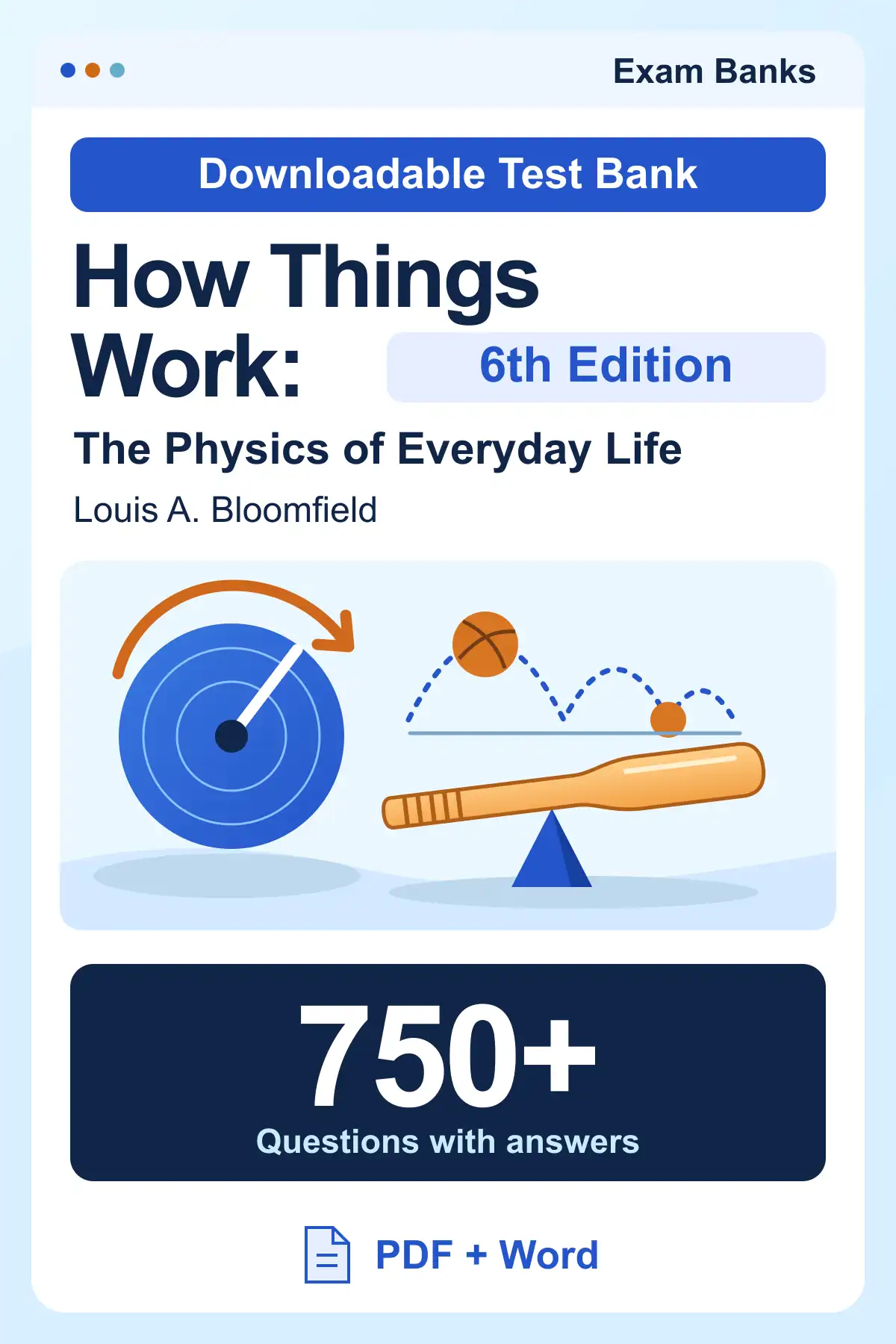
Downloadable Test Bank – How Things Work: The Physics of Everyday Life, 6th Edition (Louis A. Bloomfield)

$37.00

  • Bloomfield, 6th edition: all 15 chapters
  • 750+ practice questions with answers
  • PDF and Word files included
  • Practice the physics behind everyday objects
  • Preview 18 questions from chapters 2 and 3
  • Email delivery, generally within 8 hours
Buy Now

Description

Connect everyday objects with their physics

When your Bloomfield course asks why everyday objects behave as they do, you need practice choosing the relevant physics, as well as recalling definitions. With questions across the book, this test bank can help you work on that connection for the topics your instructor assigns.

Preview the chapter 2 and 3 samples below: decide where a tumbling bat rotates, then calculate how fast a ball rebounds.

750+questions with answers
15chapters covered
2file formats: PDF and Word

Confirm your textbook and edition

Matches this test bank: 6th edition
Book title How Things Work: The Physics of Everyday Life
Textbook author Louis A. Bloomfield
Edition 6th edition
Publisher and publication date Wiley, December 2015
Textbook ISBN 9781119013846

The ISBN identifies the textbook, not this download. Compatibility with other editions is not confirmed. Bloomfield’s How Everything Works is a different book.

What you get

Included

  • 750+ practice questions with answers
  • Questions covering all 15 chapters
  • PDF and Word files
  • Answer keys, without worked explanations

Not included

  • A printed or digital copy of the textbook
  • WileyPLUS or other access codes
  • A solutions manual for textbook exercises

18 sample questions on rotation, balance and collisions

Use the seesaw and wrench samples to check when distance from a pivot matters, then try the collision questions on forces, deformation and rebound speed. Choose your answer before selecting Show answer.

The sample below covers sections of chapter 2 and 3:

1. A flying disc spins while traveling from one person to another. Which description best matches its motion?

  • A) It rotates without changing position.
  • B) It changes position without rotating.
  • C) It rotates while also moving from place to place.
  • D) It undergoes neither rotation nor translation.
Answer: C

2. Hard nuts are easier to crush with the back teeth than with the front teeth. This is because the back teeth can apply a greater ________ to the nut.

  • A) force
  • B) torque
  • C) angular velocity
  • D) lever arm
Answer: A

3. A player tosses a baseball bat into the air, causing it to tumble as it moves. About which point does the freely moving bat rotate?

  • A) A point near the barrel end
  • B) Its center of mass
  • C) A point near the handle
  • D) Its lengthwise axis
Answer: B
Show 15 more samples

4. To balance a baseball bat horizontally on one finger, where should the finger be placed?

  • A) Just beneath the end of the handle
  • B) Just beneath the opposite end
  • C) Exactly halfway along the bat’s length
  • D) Directly beneath the bat’s center of mass
Answer: D

5. A uniform seesaw is 4 m long and supported at its midpoint. A 20 kg child sits at one end, 2 m from the pivot. Where must her 100 kg father sit on the opposite side to keep the seesaw balanced?

  • A) Beyond the end of the board
  • B) 0.5 m from the pivot
  • C) 0.4 m from the pivot
  • D) 1.5 m from the pivot
Answer: C

6. While removing a wheel, a person places their entire weight of 800 N on the free end of a horizontal wrench. If the end is 2 m from the lug nut, what torque does the person apply?

  • A) 1600 J
  • B) 1600 N·m
  • C) 800 N·m
  • D) 2 N·m
Answer: B

7. A gravity-powered race car can use either solid-disk wheels or spoked wheels with most of their mass concentrated near the rim. Both sets have the same mass and radius. Why would the solid-disk wheels help the car accelerate more quickly downhill?

  • A) Their smaller moment of inertia makes them easier to accelerate rotationally.
  • B) Their surfaces are simpler to paint.
  • C) Their larger moment of inertia allows them to retain more rotational energy.
  • D) The spoked wheels waste excessive energy warming the surrounding air.
Answer: A

8. Earth rotates from west to east. Suppose a resistive torque acts to slow this rotation. According to the right-hand rule, in which direction does that torque point?

  • A) Along the axis from the South Pole toward the North Pole
  • B) Along the axis from the North Pole toward the South Pole
  • C) Around the equator in a counterclockwise direction
  • D) Around the equator in a clockwise direction
Answer: B

9. Imagine that the Moon takes twice as long to complete one rotation about its axis. If its moment of inertia stays constant, what happens to its rotational kinetic energy?

  • A) It becomes twice its original value.
  • B) It becomes four times its original value.
  • C) It falls to one-quarter of its original value.
  • D) It falls to one-half of its original value.
Answer: C

10. The Moon’s angular velocity decreases to half its initial value while its moment of inertia remains unchanged. What is its new rotational kinetic energy compared with its original value?

  • A) Twice as much
  • B) Four times as much
  • C) One-quarter as much
  • D) One-half as much
Answer: C

18. What allows an elastic ball to rebound effectively after striking a surface?

  • A) It temporarily stores energy as it compresses and releases that energy as it regains its shape.
  • B) It stores energy by remaining permanently deformed.
  • C) Every elastic ball contains a special liquid that absorbs energy.
  • D) Elastic balls always bounce well because they are thrown correctly.
Answer: A

19. During a collision, parts of a car’s body are designed to crumple permanently. Why does this reduce the car’s tendency to bounce back?

  • A) The crumpled body stores the crash energy for later release.
  • B) Permanent deformation dissipates energy from the collision.
  • C) The deformation adds energy to the colliding objects.
  • D) Crumpling increases the car’s coefficient of restitution.
Answer: B

20. A rubber ball falls onto a floor and then rebounds. What causes its motion to change from downward to upward?

  • A) The ball must keep moving, and the floor prevents it from continuing downward.
  • B) The ball’s own momentum remains constant throughout the impact.
  • C) The ball’s own energy remains constant throughout the impact.
  • D) The floor pushes upward on the ball, first stopping its downward motion and then accelerating it upward.
Answer: D

21. A tennis ball strikes a horizontal floor at an angle and rebounds. Ignoring friction during contact, which change occurs in its velocity?

  • A) Its vertical component changes direction.
  • B) Its horizontal component changes direction.
  • C) Its speed changes to the opposite direction.
  • D) Its vertical component becomes twice as large.
Answer: A

22. A ball with a coefficient of restitution of 0.45 strikes a stationary surface head-on at 100 m/s. At what speed does it rebound?

  • A) 100 m/s
  • B) 90 m/s
  • C) 45 m/s
  • D) 45 m/s²
Answer: C

23. An elastic ball drops onto the ground and bounces upward. At which instant does it contain the greatest amount of elastic potential energy?

  • A) When it is most compressed and momentarily at rest before rebounding
  • B) Just after it leaves the ground on the way up
  • C) Immediately before it first touches the ground
  • D) When it is traveling at its highest speed
Answer: A

24. A ball strikes a stationary wall head-on at 10 m/s and rebounds at 7 m/s. What is the coefficient of restitution for this collision?

  • A) 1.41
  • B) 0.70
  • C) 0.49
  • D) −17 m/s
Answer: B

25. A bat traveling at 90 km/h meets a ball approaching directly from the opposite direction at 110 km/h. The bat maintains its speed throughout the impact. If the coefficient of restitution is 0.6, how fast does the ball travel after being hit?

  • A) 66 km/h
  • B) 200 km/h
  • C) 20 km/h
  • D) 210 km/h
Answer: D

Chapter coverage

If your next exam covers only part of Bloomfield’s book, use this list to choose the relevant topics. The sequence moves from mechanical and thermal physics to electricity, light and modern physics.

  1. The Laws of Motion, Part 1
  2. The Laws of Motion, Part 2
  3. Mechanical Objects, Part 1
  4. Mechanical Objects, Part 2
  5. Fluids
  6. Fluids and Motion
  7. Heat and Phase Transitions
  8. Thermodynamics
  9. Resonance and Mechanical Waves
  10. Electricity
  11. Magnetism and Electrodynamics
  12. Electromagnetic Waves
  13. Light
  14. Optics and Electronics
  15. Modern Physics

Delivery, file access and refunds

You’ll receive the files by email, either as attachments or through a download link. Delivery usually takes a few minutes to a few hours after payment and is generally completed within eight hours. At checkout, use an email address you can access. If the email is missing, check your spam folder.

Open the files in a PDF reader or an app that supports Word documents. No physical item is shipped.

You can request a refund before you receive the files. No refunds are offered after the files have been delivered. To request a refund before delivery, or report files missing after eight hours, contact Exam Banks with your order details.


Customer reviews

Write a review

Reviews

Be the first to review this product.

Be the first to review “Downloadable Test Bank – How Things Work: The Physics of Everyday Life, 6th Edition (Louis A. Bloomfield)”

Your email address will not be published. Required fields are marked *

Good quality.Good service.The product is firmly packed.Very fast delivery.Very well worth the money.