
Description
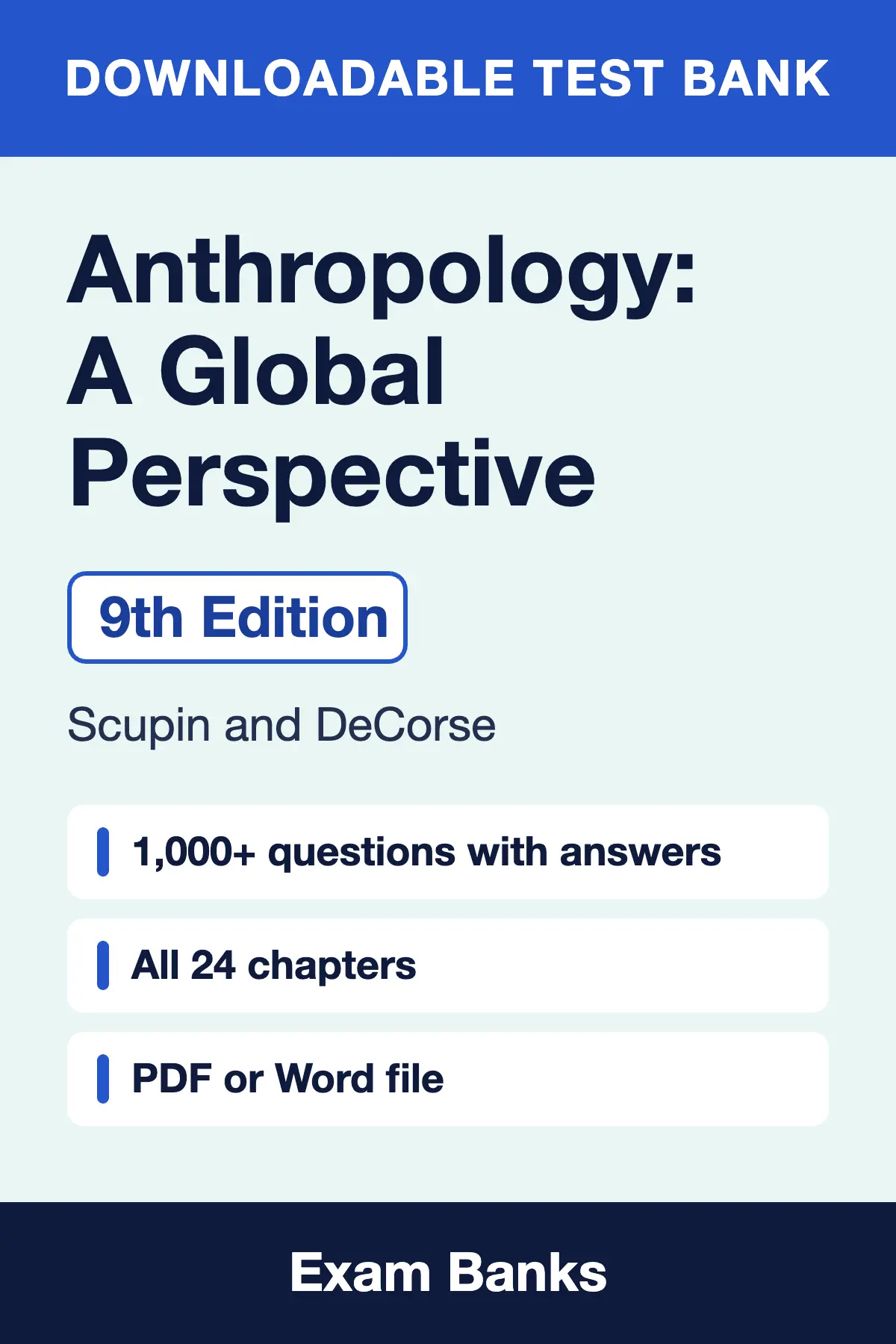
A practice question bank for the 9th edition of Anthropology: A Global Perspective by Raymond Scupin and Christopher R. DeCorse. This is the general anthropology book that runs from human evolution and archaeology through language and culture, not Scupin’s separate Cultural Anthropology book. The test bank follows all of its chapters, with an answer for every question. It is not the textbook and not a free PDF.
Check that this matches your textbook
Anthropology: A Global Perspective, 9th Edition
- Authors
- Raymond Scupin and Christopher R. DeCorse
- Publisher
- SAGE Publications
- Published
- 2021
- Paperback ISBN
- 9781544363165
- Chapters
- 24, with Chapter 18 on Gender and Sexuality
Cultural Anthropology: A Global Perspective
- Author
- Raymond Scupin
- Scope
- Cultural anthropology only, without this book’s chapters on evolution, primates and hominins
The quickest check is the publisher and one chapter title. The 9th edition is published by SAGE and has a chapter on gender and sexuality, which SAGE lists as new in this edition. If your book has no chapters on evolution, primates or the Paleolithic, you have the cultural anthropology book, which has its own test bank listed at the end of this page.
What the questions ask you to do
The 20 samples below deal with how the human past is recovered and read, the ground covered in Chapter 2, The Record of the Past. Three patterns in them matter when you prepare for an exam on this book:
- A term, then a case. Ideas come in pairs: first what taphonomy or paleoecology is (samples 5 and 9), then a field situation where you have to recognise it, such as bones with tooth marks in a deposit moved by water, or pollen used to tell woodland from grassland (samples 6 and 10).
- Wrong answers from the other subfields. Options borrow from linguistics, biology and present day observation (samples 1, 13 and 14), so you practise telling archaeology apart from the other branches the book covers.
- Method, not just vocabulary. Several items turn on recording context and planning: why a fossil lifted without notes loses its meaning, and what a research design has to contain (samples 4, 17 and 20).
That mix matters in a course built on this book, because its chapters move from fossils and primates to kinship, politics and religion, and an exam that spans several chapters will move with them.
Try 20 sample questions
These questions are copied from the test bank without changes. Choose your answer, then press Show answer to check it.
1. What is archaeology’s principal contribution to the study of human cultures?
- A. Direct observation of contemporary social interactions
- B. Material evidence of human behavior across the past
- C. Biological classification of living populations
- D. Reconstruction of language pronunciation
Answer: B. Material evidence of human behavior across the past
2. An anthropologist wants to understand how a community’s food-storage practices changed over several centuries. Which archaeological evidence would be most useful?
- A. Interviews about current shopping preferences
- B. A regional inventory of naturally occurring minerals
- C. A survey of present-day language use
- D. Storage facilities and associated remains from successive occupation layers
Answer: D. Storage facilities and associated remains from successive occupation layers
3. During the excavation of a fossil-bearing deposit, which practice is essential for preserving the scientific value of the discoveries?
- A. Recording each fossil’s precise location and relationship to surrounding deposits
- B. Grouping fossils by size before documenting where they were found
- C. Removing surrounding sediment before identifying its layers
- D. Prioritizing complete specimens over documentation of fragmentary remains
Answer: A. Recording each fossil’s precise location and relationship to surrounding deposits
Show 17 more sample questionsHide the extra questions
4. A fossil is removed from a site without recording its sediment layer or its association with nearby remains. Which aspect of interpretation is most directly compromised?
- A. Determining the specimen’s current dimensions
- B. Describing the specimen’s visible surface features
- C. Establishing the specimen’s relationship to the site’s depositional sequence
- D. Identifying whether the specimen is physically fragmented
Answer: C. Establishing the specimen’s relationship to the site’s depositional sequence
5. Which area of investigation helps researchers explain how remains accumulated, were altered, and became preserved at a fossil locality?
- A. Typology
- B. Taphonomy
- C. Linguistics
- D. Dendrochronology
Answer: B. Taphonomy
6. Researchers discover animal bones bearing tooth marks in a deposit that also shows evidence of water transport. What should they investigate before interpreting the accumulation?
- A. Whether all the animals belonged to the same species
- B. Whether the largest bones are also the oldest specimens
- C. Whether the deposit contains enough bones for exhibition
- D. How scavenging and water movement contributed to the assemblage
Answer: D. How scavenging and water movement contributed to the assemblage
7. An excavator uncovers the naturally preserved skeletal remains of a fish that lived thousands of years ago. How should the discovery be classified?
- A. An artifact
- B. A feature
- C. A fossil
- D. A midden
Answer: C. A fossil
8. Which discovery is an example of fossil evidence rather than an object manufactured by humans?
- A. A leaf impression preserved in ancient rock
- B. A stone blade with deliberately flaked edges
- C. A clay vessel recovered from a burial
- D. A bone needle with a drilled opening
Answer: A. A leaf impression preserved in ancient rock
9. Which field focuses on reconstructing ancient environments and the relationships between organisms and their surroundings?
- A. Taphonomy
- B. Paleoanthropology
- C. Dendrochronology
- D. Paleoecology
Answer: D. Paleoecology
10. A research team examines ancient pollen, plant remains, and animal species to determine whether a site was once surrounded by woodland or grassland. Which field most directly guides this investigation?
- A. Epigraphy
- B. Paleoecology
- C. Experimental archaeology
- D. Osteology
Answer: B. Paleoecology
11. Which contribution would paleontologists and geologists most directly make to an investigation of an ancient site?
- A. Translating inscriptions and reconstructing spoken dialogue
- B. Estimating the commercial value of recovered objects
- C. Interpreting fossil remains and establishing the geological history and age of deposits
- D. Determining political titles from the arrangement of buildings
Answer: C. Interpreting fossil remains and establishing the geological history and age of deposits
12. An excavation uncovers fossil animals within sediment layers separated by volcanic ash. Why would collaboration between paleontologists and geologists be particularly valuable?
- A. Their expertise can connect the fossil evidence with the site’s geological sequence and chronology
- B. Their expertise can establish the exact social status of the individuals associated with the deposits
- C. Their analyses can replace the need to record the positions of recovered specimens
- D. Their analyses can determine the original names given to local animal species
Answer: A. Their expertise can connect the fossil evidence with the site’s geological sequence and chronology
13. Which student’s primary interest most closely aligns with the central purpose of archaeology?
- A. Studying the chemical composition of modern industrial materials
- B. Investigating how people lived in the past through the material evidence they left behind
- C. Classifying living organisms according to their genetic relationships
- D. Examining how atmospheric conditions influence daily weather
Answer: B. Investigating how people lived in the past through the material evidence they left behind
14. Which research question would most directly fit an archaeological investigation?
- A. How does atmospheric pressure affect tomorrow’s rainfall?
- B. How do inherited traits influence the coloration of living insects?
- C. How does a modern language encode grammatical tense in conversation?
- D. How did household organization change as an ancient settlement expanded?
Answer: D. How did household organization change as an ancient settlement expanded?
15. Beyond fieldwork, which activity forms a substantial part of contemporary archaeological and paleoanthropological research?
- A. Producing commercial appraisals of privately owned antiquities
- B. Reconstructing complete historical narratives from individual objects
- C. Using computers to analyze evidence, consult research, and prepare findings
- D. Locating sites primarily through accounts of legendary cities
Answer: C. Using computers to analyze evidence, consult research, and prepare findings
16. After completing a field season, an archaeologist uses a geographic information system to compare the locations of tools, hearths, and food remains. What is the main research purpose of this work?
- A. Identifying spatial patterns that may reveal how people used the site
- B. Assigning precise calendar dates to every object based on its location
- C. Determining the biological ancestry of the site’s inhabitants
- D. Replacing field observations with simulated excavation records
Answer: A. Identifying spatial patterns that may reveal how people used the site
17. Before beginning fieldwork, a researcher specifies the project’s questions, excavation scope, sampling procedures, and analytical methods. What is the researcher developing?
- A. A fossil inventory
- B. A stratigraphic sequence
- C. A typological classification
- D. A research design
Answer: D. A research design
18. A team wants to investigate whether households in an ancient settlement had unequal access to imported goods. Which plan best connects the research question with an appropriate investigation?
- A. Excavate only the largest residence and apply its findings to the entire settlement
- B. Sample different households and compare imported objects from comparable occupation periods
- C. Collect visually distinctive objects without recording their household associations
- D. Combine materials from all periods before comparing the quantities recovered
Answer: B. Sample different households and compare imported objects from comparable occupation periods
19. Which document establishes an archaeological project’s objectives and explains how the evidence needed to address them will be recovered?
- A. A research design
- B. An artifact catalogue
- C. A site condition report
- D. A specimen conservation record
Answer: A. A research design
20. An archaeological proposal lists excavation techniques and laboratory equipment but does not identify the questions the project will investigate. What is its most significant weakness?
- A. It does not predict the exact number of artifacts that will be recovered
- B. It does not provide final interpretations before excavation begins
- C. It does not explain how the proposed methods will address defined research objectives
- D. It does not specify the exhibition arrangement for the recovered materials
Answer: C. It does not explain how the proposed methods will address defined research objectives
Chapters covered
All 24 chapters of the 9th edition. Chapters 2 to 9 are the biological and archaeological half of the course, from evolution and the primates to the rise of the state.
- Chapter 1: Introduction to Anthropology
- Chapter 2: The Record of the Past
- Chapter 3: Evolution
- Chapter 4: The Primates
- Chapter 5: Hominin Evolution
- Chapter 6: Human Variation
- Chapter 7: The Paleolithic
- Chapter 8: The Origins of Domestication and Settled Life
- Chapter 9: The Rise of the State and Complex Society
- Chapter 10: Culture
- Chapter 11: The Process of Enculturation: Psychological and Cognitive Anthropology
- Chapter 12: Language
- Chapter 13: Anthropological Explanations
- Chapter 14: Analyzing Sociocultural Systems
- Chapter 15: Environment, Subsistence, and Demography
- Chapter 16: Technology and Economics
- Chapter 17: Social Structure, the Family, Marriage, and Age
- Chapter 18: Gender and Sexuality
- Chapter 19: Politics, Warfare, and Law
- Chapter 20: Religion and Aesthetics
- Chapter 21: Globalization, Culture, and Indigenous Societies
- Chapter 22: Globalization, Colonialism, and Postcolonialism
- Chapter 23: Ethnicity
- Chapter 24: Applied Anthropology
What you get
Included
- Over 1,000 questions, each with its correct answer
- Multiple choice, true or false and short answer questions
- Questions for every one of the 24 chapters
- A PDF or a Word file, whichever you prefer: tell us after you order
Not included
- The textbook itself, in print or as an eBook
- SAGE Vantage access or codes
- Answers to the textbook’s own end of chapter questions
Delivery and refunds
Delivery: by email, as an attachment or a download link, usually within a few minutes to a few hours of payment and generally within eight hours. Check your spam folder if it has not arrived.
Payment: credit or debit card, or PayPal.
Refunds: you can get a refund if you have not yet received your files. Once the files are delivered the sale is final, so compare the samples and the edition details above before you order.
Seller: Exam Banks is an independent seller and is not affiliated with SAGE or its authors. Questions before you buy: info@exam-banks.com
Related test banks
- Cultural Anthropology: A Global Perspective test bankRaymond Scupin, 10th edition Same author, different book
- Anthropology: What Does It Mean to Be Human? test bankLavenda, 3rd edition
- The Human Story: An Introduction to Anthropology test bankBrewis
- Our Origins: Discovering Physical Anthropology test bankLarsen




Reviews
Be the first to review this product.